
Picture this: you’ve been wronged. You summon the courage to complain. You expect justice, or at least daylight. Instead, you’re ushered onto a fairground ride — the Complaints Carousel. It goes round and round, operated by the very people you’re complaining about, while a man in a hi-viz jacket assures you this is accountability. Welcome aboard: justice not included, refunds unavailable.
How the Carousel Spins (in plain English)
You complain. West Mercia’s Professional Standards Department (PSD) takes your case. Translation: the force investigates itself.
They decide. You receive a tidy letter sprinkled with “service recovery” and “lessons learned” Your experience is acknowledged; your allegation, not so much.
You ask for a review. By law, the “relevant review body” (that’s the PCC) checks whether the handling and outcome were reasonable and proportionate. It is not a reinvestigation. No fresh witnesses. No new facts. Just a second look at the first look.

Independence, but make it familiar. The PCC’s office sends your file to an “independent reviewer” — typically a private outfit (Sancus Solutions Ltd) staffed by former professional-standards managers. They know the rules, they know the culture, and they know exactly how to decide whether the paperwork just about supports the conclusion.
Final letter. The PCC signs the decision. Unless you fancy judicial review (and a second mortgage), that’s your lot.
Result: a system that certifies dissatisfaction rather than resolves it.
The “Reasonable & Proportionate” Party Trick
Here’s the gag: the review doesn’t ask “Was this right?” It asks, “Could a sensible person, after squinting at this file, plausibly nod?” That’s not justice; that’s quality control.
No fresh witnesses. No awkward fact-finding. No daylight. Just a second opinion on whether the first opinion looks tidy enough to pass as reasonable.
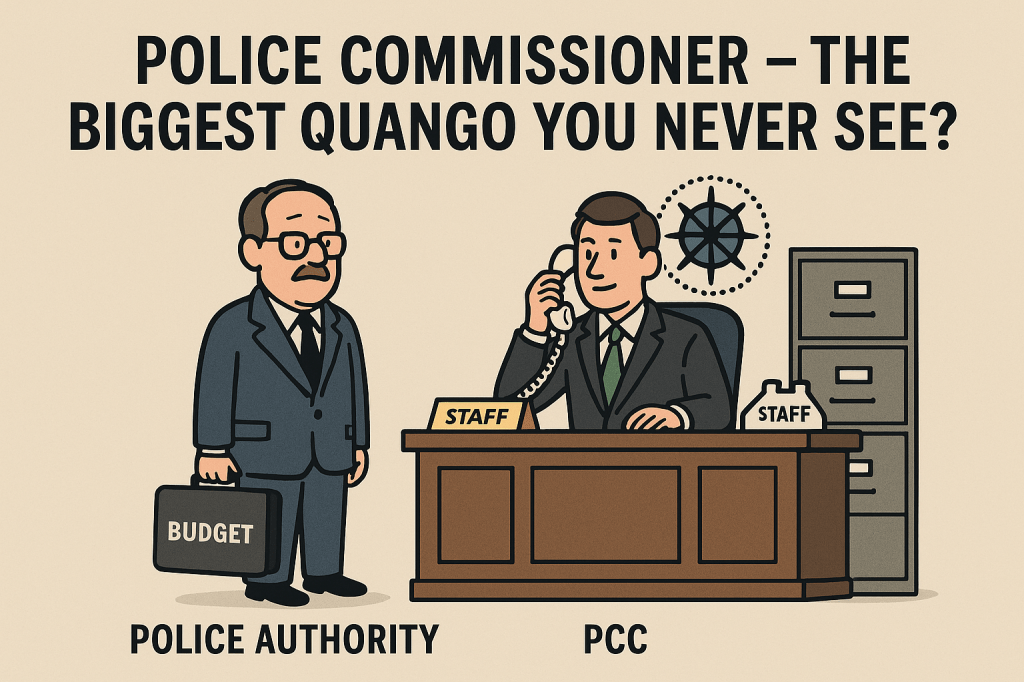
Think of it as an MOT for bad decisions: if the indicators blink in the report and the policy wipers swipe on command, it’s a pass — never mind the engine falling out on the A5.
It creates a perfect little perverse incentive: don’t fix a weak investigation, format it. The cleaner the paperwork, the safer the error.
Truth is optional. Template compliance is compulsory.
If the paperwork is pristine, the public loses. Again.
Outsourced Independence (and the optics)
You wanted an appeal. You got a peer review — by the professional-standards alumni club.
The “independent” reviewers are drawn from the same fraternity that wrote the rulebook. Same training, same instincts, same well-developed ability to find a defensible paragraph where a remedy ought to be. Independence here doesn’t mean free of influence; it means billing by the hour.
And the headliners? Alumni of the Metropolitan Police — yes, that Metropolitan Police, freshly emerged from a long spell in “enhanced monitoring”. Nothing says “public confidence” like graduates of a force in intensive care now selling bedside manner to everyone else.
The job isn’t to excavate truth; it’s to stabilise the paperwork. If a victim needs justice but a file needs tidying, the file wins. The review asks, in effect, “Can this be made to look reasonable?” and not “Is this actually right?”
Think of it as the old boys marking their own homework — only this time the invigilator’s brother runs the marking service and he’s still wearing the school tie.
No fresh evidence, no witnesses — just a desk-based plausibility test.
Reputation management, not remedy.
If Professional Standards were part of the problem, why are professional-standards lifers now sold as the solution?
Transparency: Batteries Not Included
Welcome to the information vending machine: insert FOI, receive “commercially sensitive” by return. The two magic spells are s43(2) (abracadabra: trade secrets) and s36(2)(c) (it would harm the conduct of public affairs). Say the words slowly and — poof — your public interest vanishes in a puff of black marker.
And when the watchdog finally prises the lid off, what tumbles out? Not nuclear codes — boilerplate GDPR clauses and a contract spec with half the nouns coloured in. The message is unmistakable: the public may pay for the system, but the public may not see how the system works.
In this carousel, transparency arrives like an ambulance in rural Shropshire: late, begrudging, and missing half the kit. You ask who gets your data, on what legal basis, for how long; who signs, who pays, how much per-case; the uphold rate, the overturn rate, the remedies used. You get a soothing paragraph and a PDF that’s had an argument with a black felt tip pen.
Publish, or stop pretending:
The full contract, unredacted (spare us only bank details).
The Data-Sharing Agreement and processing schedule (who, what, why, how long).
The per-review fee table and monthly totals.
Volumes, timeliness, uphold/overturn rates, and the remedy breakdown.
The reviewer instructions/criteria and quality-assurance checks.
Retention, audit logs, destruction policy for citizen data.
Rule of thumb: transparency you have to litigate for is not transparency. It’s reputational management with stationery.
The Democratic Swindle (with Complimentary Remedies)
Here’s the trick: PCCs were sold as putting you in charge; what you actually got is a pantomime courtroom. The villain plays the judge, the chorus chants “reasonable and proportionate”, and every time you shout “Oh no it isn’t,” the script replies “Oh yes it is.” The “independent” decision is ghost-written by consultants from the same professional guild as the original investigators and signed off by a politician’s office that calls this accountability.
Turnout that wouldn’t satisfy a village fête becomes a licence to manage perception; procurement converts it into a paid service to manage you.
If justice were the point, outcomes would change. Here, only the script does. The curtain falls; nothing moves except the scenery. The door marked closure is a revolving one.
Fix It — or Stop Pretending
Publish everything: contracts, per-case fees, volumes, turnaround, uphold rates, and full reasons where decisions are changed.
Real independence: reviewers with no professional allegiance to police PSDs, with powers to seek further evidence and test competing accounts.
A proper remedy: where the original investigation is plainly poor, require a fresh investigation outside the original chain — not a reflective shrug.
Or admit the truth. This isn’t oversight; it’s theatre. A carousel of paperwork spun by alumni of the same guild, sold as independence, signed off by a politician with a slogan. If PCCs can’t deliver justice, then stop charging the public admission for this ride. Pull down the tent, sack the ringmaster, and build an oversight body that actually answers to the people — not the profession. Until then, the Complaints Carousel keeps turning, fuelled by your frustration and funded by your taxes.
 The Alternative Council
You need to publish a book on this very subject.
LikeLiked by 1 person