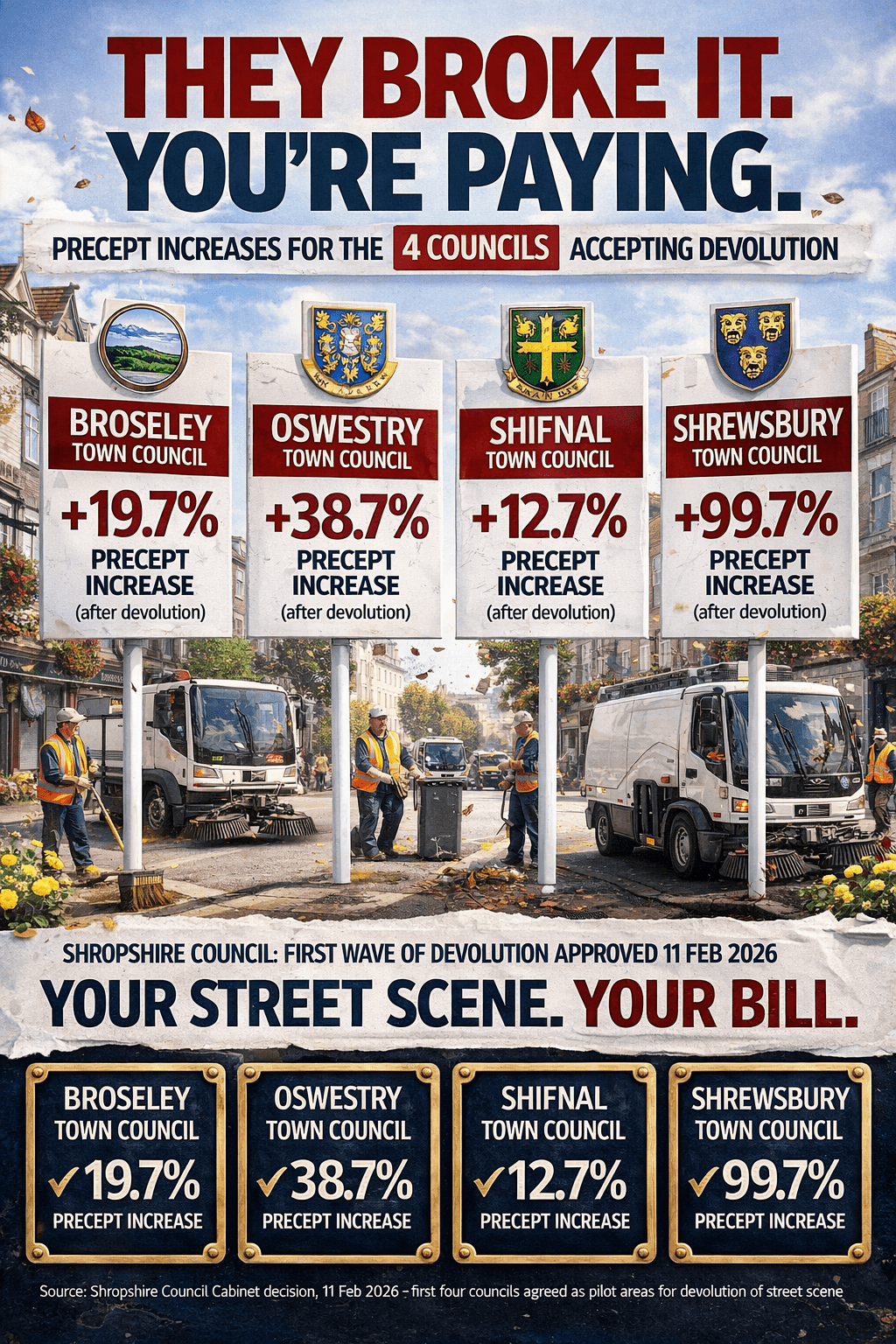
There is a well-rehearsed trick in local government.
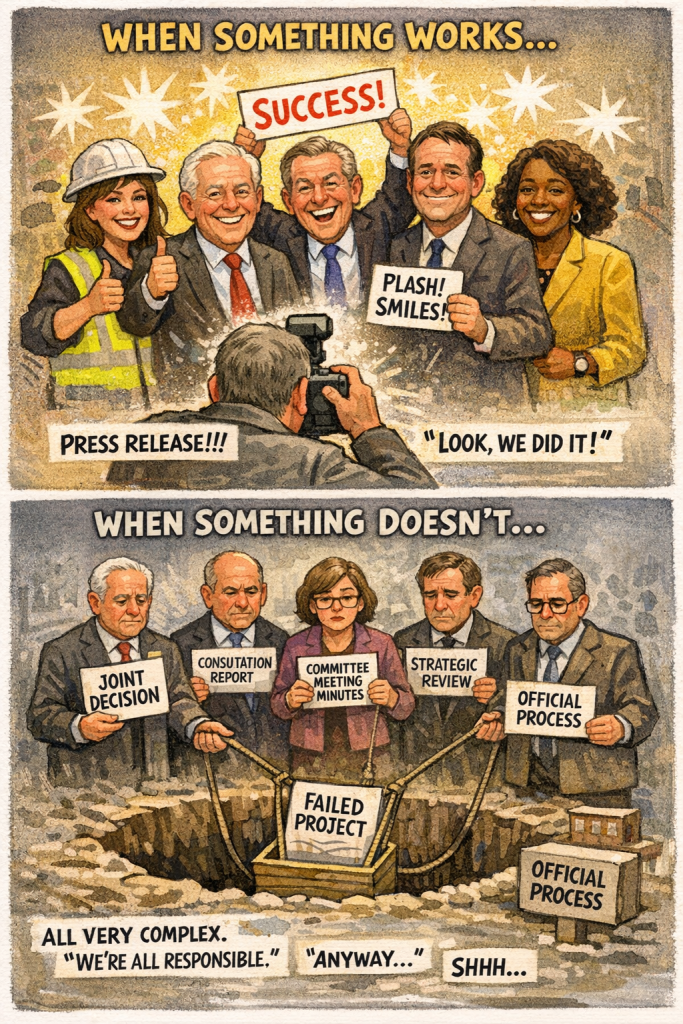
When something works, there are photographs, press releases, and smiling faces.
When something doesn’t, it becomes a “collective decision”, wrapped in process and gently lowered into obscurity.
Shropshire Council’s grandly titled “devolution of services” now sits firmly in that second category.
Because this didn’t just happen.
It was written, presented, debated and approved — by named people — on 11 February 2026.
The Meeting That Moved the Cost
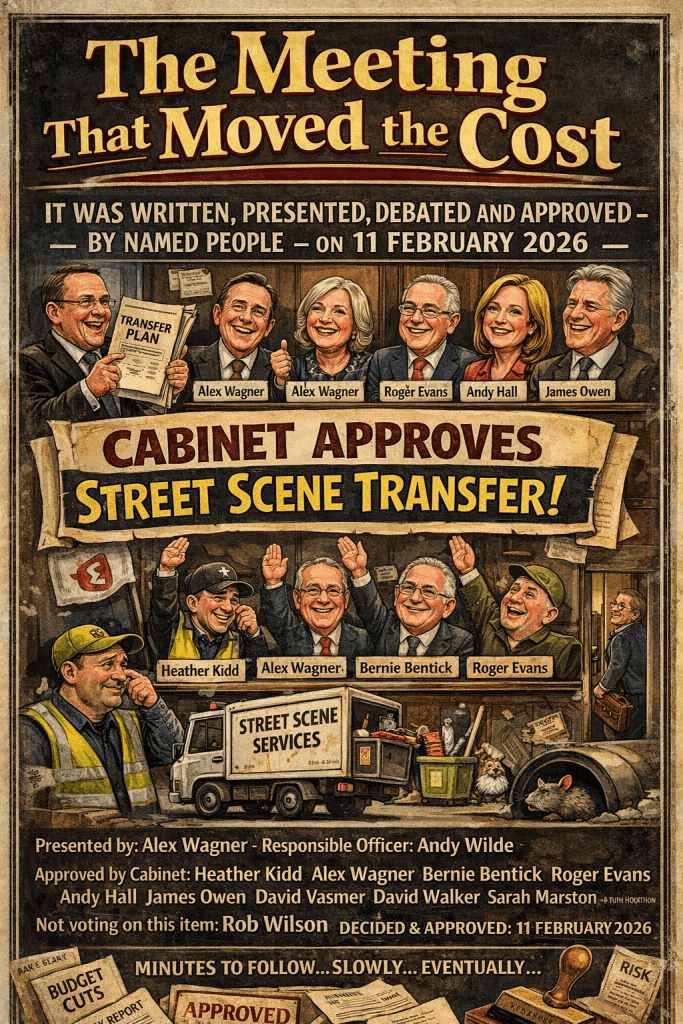
On that date, Cabinet approved the transfer of what it politely calls Street Scene services:
- grass cutting
- litter picking
- street cleaning
- bin emptying
The people in the room were:
- Heather Kidd — Leader
- Alex Wagner — Deputy Leader (and lead member for the report)
- Bernie Bentick
- Roger Evans — Finance
- Andy Hall
- James Owen
- David Vasmer — Highways and Environment
- David Walker
- Sarah Marston (substituting)
Rob Wilson was present, declared an interest, and left the room.
The report itself was led by Andy Wilde, supported by senior officers across finance, legal and strategy.
Nothing about this was accidental. Nothing about it was unclear.
What They Approved (Without Saying It Plainly)
The language is careful.
You will read about:
- “local flexibility”
- “community empowerment”
- “tailored delivery”
What you will not find — at least not in a sentence anyone would recognise — is this:
The Council keeps the legal responsibility,
the towns take on the work,
and the public picks up more of the cost.
The Bit Where It Starts to Smell
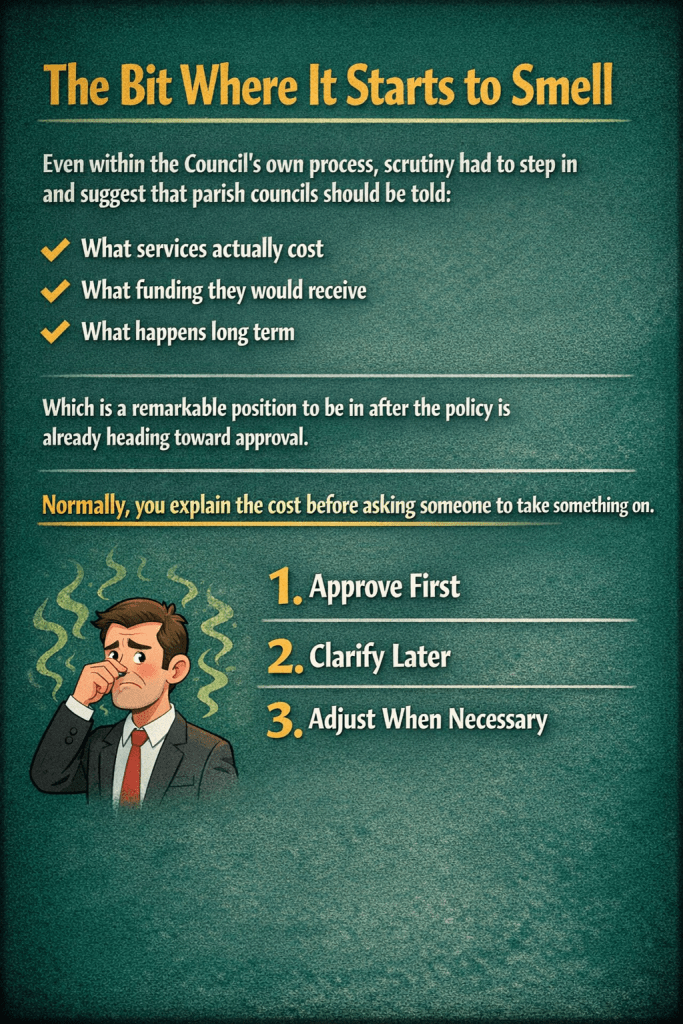
Even within the Council’s own process, scrutiny had to step in and suggest that parish councils should be told:
- what services actually cost
- what funding they would receive
- what happens long term
Which is a remarkable position to be in after the policy is already heading toward approval.
Normally, you explain the cost before asking someone to take something on.
Here, it appears to be:
- approve first
- clarify later
- adjust when necessary
What Happens If a Parish Refuses?
There is a question sitting quietly underneath all of this.
It is not answered in the reports.
It is not explained in the briefings.
It is this:
What happens if a parish council simply says “No”? Because this is supposed to be a choice.
The Official Version
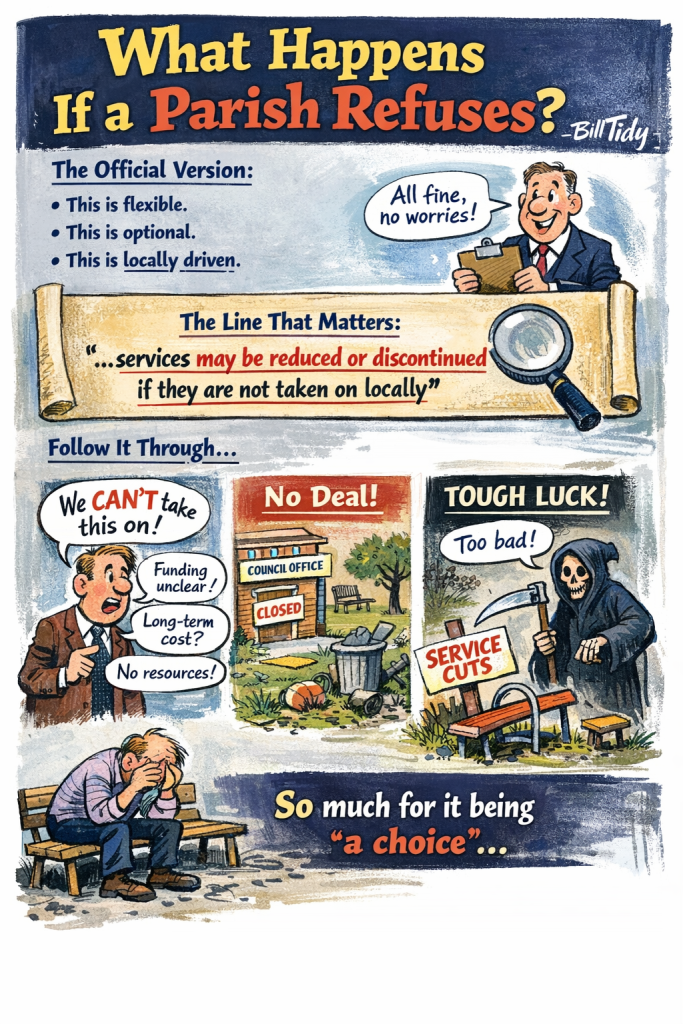
You are told:
- this is flexible
- this is optional
- this is locally driven
All very reassuring.
The Line That Matters
Then you find the sentence that does the real work:
services may be reduced or discontinued if they are not taken on locally
There it is.
Not highlighted. Not emphasised. Just quietly sitting there.
Follow It Through
A parish council refuses.
Perfectly reasonably, it says:
- the funding isn’t clear
- the long-term cost isn’t guaranteed
- we don’t have the staff or equipment
So it declines.
Scenario One — The Service Stays (Worse)
Shropshire Council retains the service.
But it has already said it cannot afford the current level.
So:
- grass is cut less often
- litter remains longer
- bins fill up
Nothing disappears.
It just deteriorates.
Scenario Two — The Service Exists on Paper
The quieter version.
The service is still “there”, but:
- standards fall
- response times slip
- expectations reset
Officially unchanged.
Practically reduced.
Scenario Three — The Pressure Returns
And then, inevitably:
- complaints increase
- residents notice
- pressure builds
And the parish is asked again.
Only now, it doesn’t feel like a choice.
What This Means for You
Take a typical Band D household.
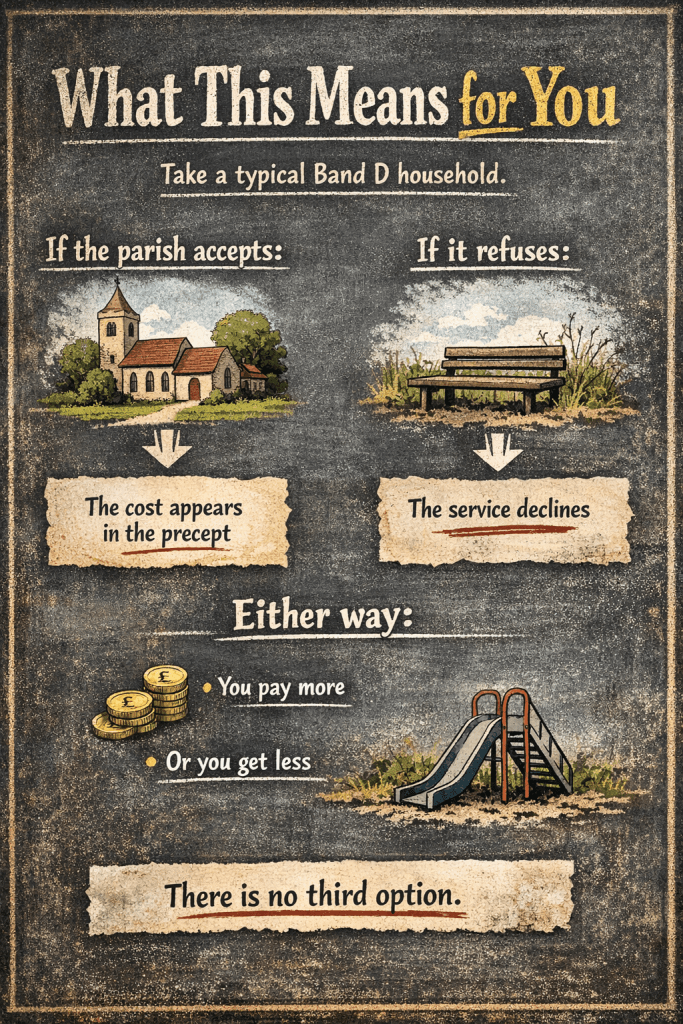
If the parish accepts:
- the cost appears in the precept
If it refuses:
- the service declines
Either way:
- you pay more
- or you get less
There is no third option.
The Structure — Now Impossible to Deny
| Who | What |
| Shropshire Council | Keeps legal responsibility |
| Town & Parish Councils | Deliver services |
| Residents | Fund the gap |
This is not interpretation.
It is the model.
And Who Designed This?
Let’s go back to that room.
This was approved under the leadership of:
- Heather Kidd
- Alex Wagner (lead member)
- Roger Evans (Finance)
- David Vasmer (Environment — the services in question)
Alongside:
- Andy Hall
- Bernie Bentick
- James Owen
- David Walker
Supported by senior officers including:
- Andy Wilde (lead officer)
- Tanya Miles
- Mannie Ketley
- Clare Williams
- Tim Collard
- Paul Clarke
- Duncan Whitfield
These are not background figures.
These are the people who:
- saw the model
- understood the finances
- and approved it
Conclusion: The Decision Has Owners
This was not done by “the Council”.
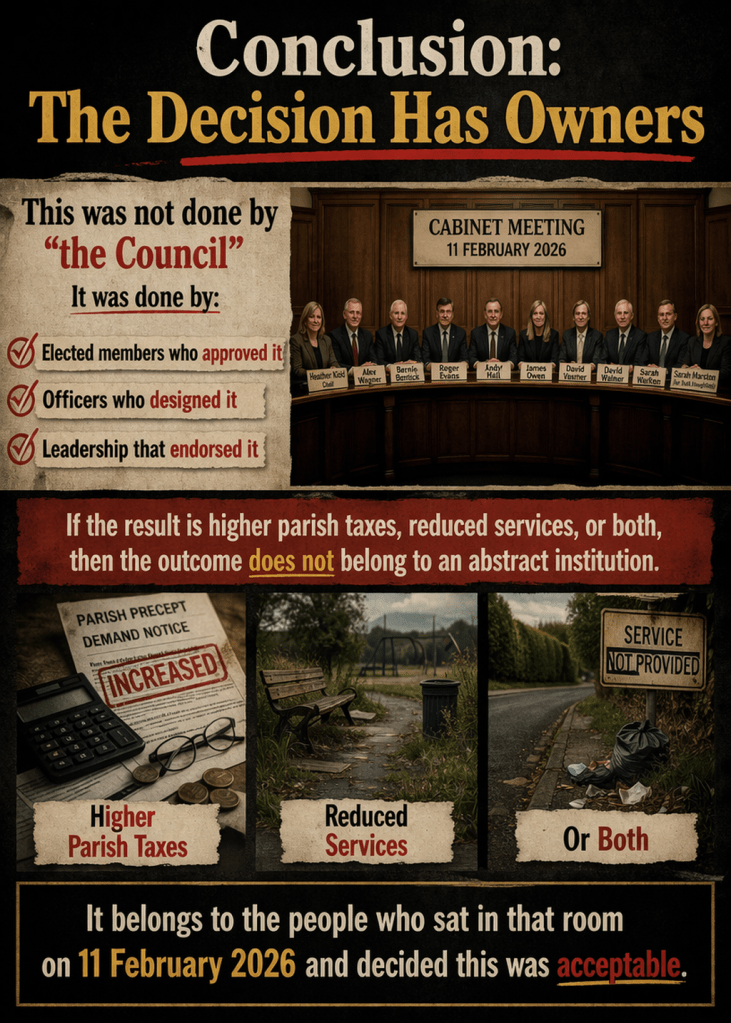
It was done by:
- elected members who approved it
- officers who designed it
- leadership that endorsed it
If the result is higher parish taxes, reduced services, or both, then the outcome does not belong to an abstract institution.
It belongs to the people who sat in that room on 11 February 2026 and decided this was acceptable.
So when your council tax rises for the privilege of watching services wither, remember that this was sold as devolution by the very people who could not run it themselves and decided you might enjoy paying for their failure locally.
 The Alternative Council