
Cornovii Developments Ltd is Shropshire Council’s wholly owned housing company, set up in 2019 amid talk of housebuilding, quality control and financial return. It was presented as a bold instrument of delivery and a sensible bit of municipal enterprise. It has since acquired the more familiar local-government aroma of opacity, mission drift and soothing quarterly paperwork.

There is something almost touching about the Housing Supervisory Board.
Not in the admirable sense, obviously. More in the sense of a body of councillors being tucked up each quarter with a nice officer-prepared blanket, a few soft numbers, a spoonful of managerial syrup, and a recommendation to ‘note’ events while the real questions wait patiently outside in the rain.
The latest 3rd Quarter Monitoring Report for Cornovii is a fine specimen of the genre. It tells members that the March 2025 business plan aimed for 582 homes, but the forecast has now been reduced by 50 to 532. It also tells them that Cornovii has moved into the private rented sector, now holds 41 PRS properties and 9 Rent to Own homes, and has generated £0.440m in rental income with £0.922m in capital growth. And what are members invited to do with this strategically significant shift in model, delivery and exposure? Why, note it, naturally. Note the progress. Note the updated delivery profile. Note the tenure mix. Note the financial performance. A sort of ceremonial nodding exercise dressed up as governance.

All this would be troubling enough in any well-run authority. It looks rather worse when set against the scale of the public exposure around Cornovii, commonly put at around £68 million, depending on the measure and date used. At that level, a supervisory board that merely “notes” developments begins to look less like oversight and more like ritual.
One might have imagined that a body called the Housing Supervisory Board would supervise. That it might ask what caused the 50-home shrinkage. That it might inquire when the move into PRS was approved, by whom, on what appetite for risk, and with what exit strategy. That it might wonder how a council-owned company in a financially distressed authority drifts into Rent to Own products and landlord territory while the public is expected to clap politely at the phrase ‘tenure diversification’. But no. The public paper asks members merely to receive the officer lullaby and move on.
This would be less striking if the official description of the Board were equally modest. It is not.
When pressed, the Monitoring Officer quoted the constitutional function of the HSB as exercising ‘the functions of the Council as the sole Shareholder in the Local Housing Company in order to provide oversight of the company’s actions and performance.’ That is not decorative language. It is not the wording of a tea committee, a box-ticking society, or a quarterly audience for upholstered PowerPoint. It is the language of an oversight body that is meant to do more than admire a progress report and murmur sympathetically about ‘market conditions’.
Yet in the same email chain, Cllr Rosemary Dartnall described the Board’s role in much gentler terms, saying that it provides only a ‘high level overview’ of Cornovii’s performance in delivering the agreed business plan. There, in one convenient exchange, is the whole shabby little problem. The Constitution says oversight of the company’s actions and performance. The chair says high level overview. One of those sounds like supervision. The other sounds like peering at the menu through the restaurant window and declaring dinner a success.
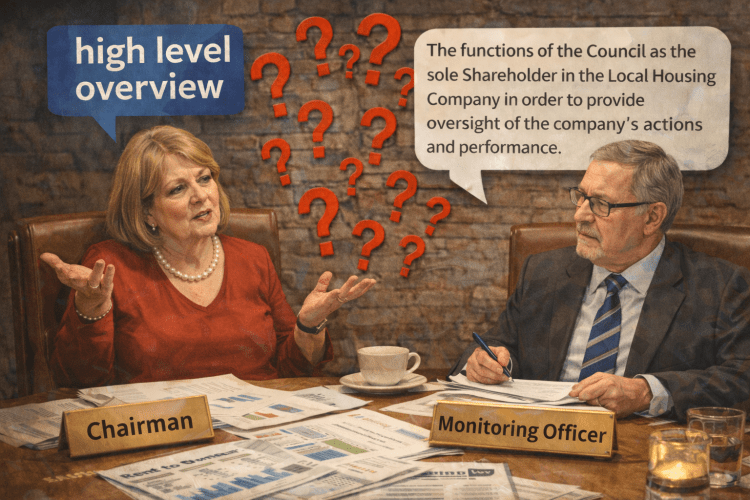
And so the obvious question arises. Which is it?
If the Board truly exists to exercise shareholder oversight, where is the visible trail of challenge? Where are the papers showing when members were first told about the move into PRS? Where are the briefings on Rent to Own? Where is the evidence that anyone around the table demanded clarity on debt exposure, management costs, void risk, interest burden, sensitivity to market weakness, or the basis of these conveniently glossy capital growth numbers? Where is the record of scrutiny over Kettel and the wider re-shaping of Cornovii’s model? If all this exists, splendid. Produce it. If it does not, then the word ‘supervisory’ has been doing some very heavy lifting indeed.
The cast list makes the whole thing even more picturesque. The original political and officer architecture around the Cornovii adventure has thinned out rather dramatically. Former councillor Dean Carroll is no longer there and did not stand again in Battlefield in 2025. Mark Barrow had already left the Council earlier in 2025. Andy Begley announced in September 2025 that he would leave. James Walton confirmed in January 2026 that he was leaving at the end of that month. The old authors of municipal optimism drift away, one by one, while the paperwork stays behind like cigarette smoke in a committee room.
That, perhaps, is the most local-government part of all. The architects depart. The strategy mutates. The delivery shrinks. The tenure risk expands. The financial backdrop worsens. The language gets softer. And the supervisory board is handed another quarterly comfort blanket and told to ‘note’ matters while the public is invited to marvel at the upholstery.

I have referred before to the Housing Supervisory Board as a body that risks looking less like a watchdog and more like a municipal sedative delivery mechanism. Having now read the latest report and the subsequent exchanges, I am tempted to improve the taxonomy.
A group of owls is a parliament.
A group of crows is a murder.
And a group of councillors gathered around Cornovii, swaddled in quarterly reassurance and told not to trouble themselves unduly with the missing hard edges of scrutiny, may properly be described as a naivety of councillors.
Cruel? Perhaps.
Unfair? That depends on the records.
Because that is now the whole point. If the Board has genuinely supervised Cornovii in the robust sense claimed by the Constitution, the documents will exist. The minutes, the reports, the briefings, the member notes, the email decisions, the due diligence references, the challenge, the concern, the assurances sought, the questions asked in bad temper behind closed doors. All of it.
And if those records do not exist, then the quarterly report was never a tool of oversight at all.
It was a comfort blanket.
A dog that does not bark.
And the public was expected to mistake it for adult supervision.
 The Alternative Council