
Who Shropshire’s Housebuilding Boom Is Really For
There is something almost touching about the way large housing developments are sold to the public in Shropshire.
A field is selected. A map appears. A developer starts speaking in that warm, managerial tone about “meeting need”. Councillors murmur about “balance”. Officers reach for policy references and begin chanting them like medieval clergy. Then, before long, another town or village is informed that hundreds of houses are not really a decision at all, merely the unavoidable unfolding of destiny.
Rain falls. Wind blows. Fields vanish. Democracy nods along politely.
Take Oswestry
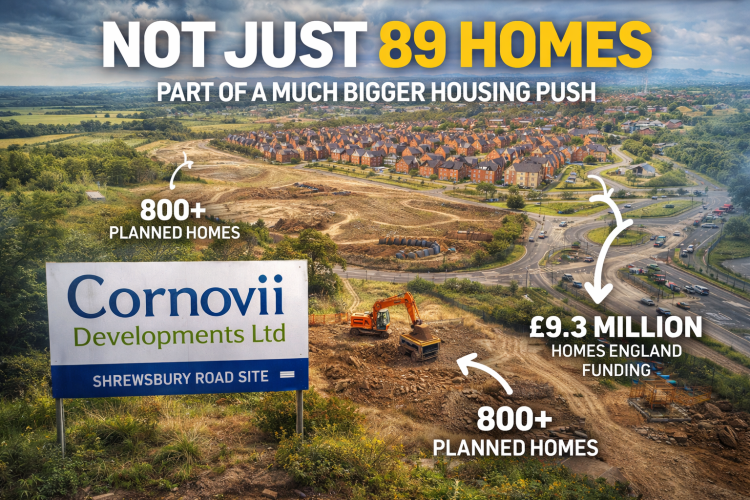
The Cornovii Developments Ltd site off Shrewsbury Road near Mile End Roundabout is said to be about 89 homes, which on its own sounds almost modest by modern standards. Just a small local scheme, apparently, nothing to trouble the horses or disturb anyone still clinging to the quaint belief that planning should primarily serve local people.
Except this is not some isolated patch of development. It sits within the wider Eastern Gateway Sustainable Urban Extension, an area tied in public documents to around 800 to 900 homes, and conveniently assisted by £9.3 million of Homes England-backed infrastructure funding for the Mile End Roundabout works. So what is presented as a tidy little scheme is in reality one cog in a much larger machine.
And here the smell becomes rather stronger
Because Cornovii Developments Ltd is not just any developer drifting in from afar with a glossy brochure and a gift for euphemism. It is tied to the very local authority structure that is supposed to stand at arm’s length from the planning consequences of this sort of expansion. The result may not be a conflict of interest in the narrow legal sense unless one proves a direct personal interest, but it has all the hallmarks of a structural conflict of interest or, at the very least, an appearance of one so strong you could hang bunting on it. The council promotes growth, facilitates infrastructure, oversees the planning framework, and then appears through its own development machinery in the very landscape being transformed. That is not a healthy separation of powers. It is the public sector version of marking your own homework, then awarding yourself a distinction for objectivity.
The committee report says 10% affordable housing is to be secured later by legal agreement. How reassuring. Ten per cent. A token garnish of affordability sprinkled over a much larger platter of strategic expansion. One can almost hear the applause from the housing waiting list.
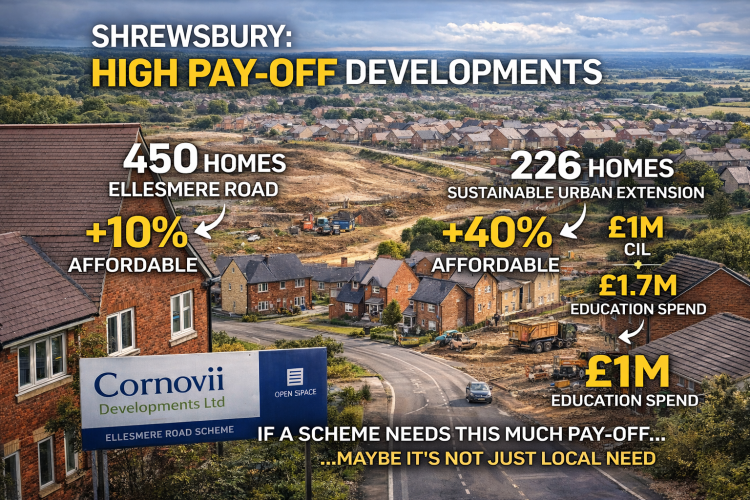
In Shrewsbury, officers have supported up to 450 homes on Ellesmere Road, with a mix of 2-bed to 5-bed properties, and just 10% affordable housing. Elsewhere, south of the town, another 226 homes have gone through as part of the Sustainable Urban Extension, with 40% affordable housing, around £1 million in CIL, £1.7 million for education, a bus route and open space measures bundled in as planning mitigation. Which is useful, because the legal obligations tell the truth even when the sales language does not. If a scheme needs all that money and all those compensatory measures to make it vaguely tolerable, then perhaps the strain it creates is rather greater than the public relations brochure suggests.
Homes England, meanwhile, should stop pretending to be merely a helpful national facilitator. In places like Oswestry, it looks more like the state-sponsored accelerant of speculative expansion, supplying the infrastructure money that turns contested growth into “deliverable” growth and then leaving local communities to cope with the consequences. Mile End was not upgraded for the sheer romance of road engineering. It was backed to unlock development. Once that is understood, the cosy fiction that these schemes simply emerge from local need starts to look rather threadbare.
This is the wider trick now being played across Shropshire
Near Bridgnorth, subtlety has already packed its bags and gone home. Tasley Garden Village has approval for up to 1,500 homes, with 20% affordable housing. That sounds grand until one remembers the arithmetic. Roughly 300 affordable homes, leaving the other 1,200 to the tender mercies of the market. This is always the trick, is it not? Announce the affordable proportion as if it were the headline, while quietly building the real business model underneath it.
Even the smaller schemes tell their own story. In Hadnall, a 44-home development comes with a published mix of 13 two-bed, 19 three-bed and 12 four-bed homes, plus five bungalows. A proper spread, properly dressed up, and accompanied by a Section 106 package for affordable housing, biodiversity, drainage and open space. Which means yet again that the development has to drag behind it a cart full of remedies simply to offset the problems it is likely to create.
And then there is Telford & Wrekin, which at least has the decency to be blunt about its ambitions. Lawley means up to 250 homes, 25% affordable housing and over £2.8 million in Section 106 contributions. St Georges brings about 80 homes, with 25% affordable housing and more obligations tied into the legal agreement. Priorslee East keeps rolling forward towards 1,100 homes. Beyond that, the borough’s northern growth areas at Bratton, Muxton and Wappenshall point towards roughly 8,000 homes in the longer pipeline. Telford does its expansion in industrial quantities. Shropshire prefers a slower method, adding enough schemes in enough places that residents eventually lose count and call it progress.
The official language for all this remains wonderfully pious
We are told of “delivery”, “need”, “strategic growth”, “sustainable communities” and “future provision”. The implication is that all this is happening for the good of the existing public, who should presumably be grateful that their roads, schools, surgeries and drainage systems are being pushed into a permanent state of near-collapse in the cause of national virtue.
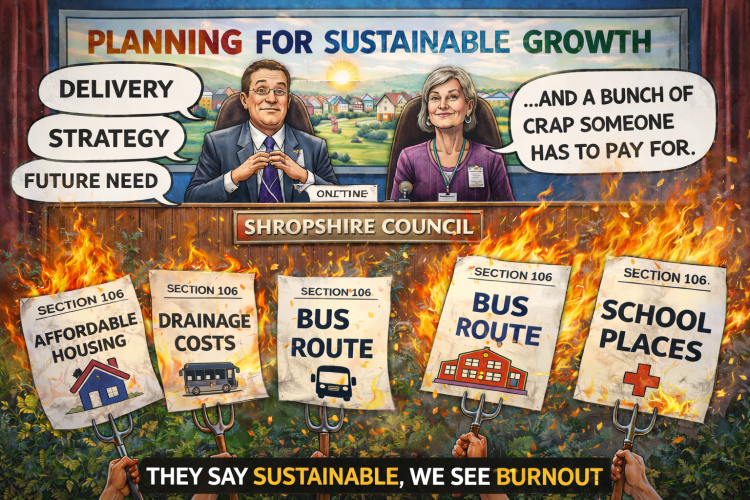
But the reports themselves tell a less flattering story. Again and again they point to Section 106 obligations for affordable housing, public open space, biodiversity net gain, drainage, highways, education, healthcare and transport mitigation. In plain English, that means the very people waving these schemes through know perfectly well they carry consequences which must somehow be paid for, softened, disguised or postponed.
And still the central question is rarely put bluntly enough
Homes for whom?
Because much of this does not look like a calm and disciplined effort to house local young people, local families or local older residents wishing to downsize. It looks like broad-market expansion aimed at whoever can buy: local movers, regional commuters, upsizers, downsizers, equity-rich incomers and buyers drifting in from stronger neighbouring markets. Oswestry’s Mile End corridor is not being reshaped out of tender concern for those already rooted there. Shrewsbury’s fringe is not filling up purely because someone in Monkmoor cannot find a starter home. Bridgnorth and Albrighton are not immune from commuter demand from further east. Much of this reads less like local housing policy and more like managed demand importation.
That is where the real bitterness lies
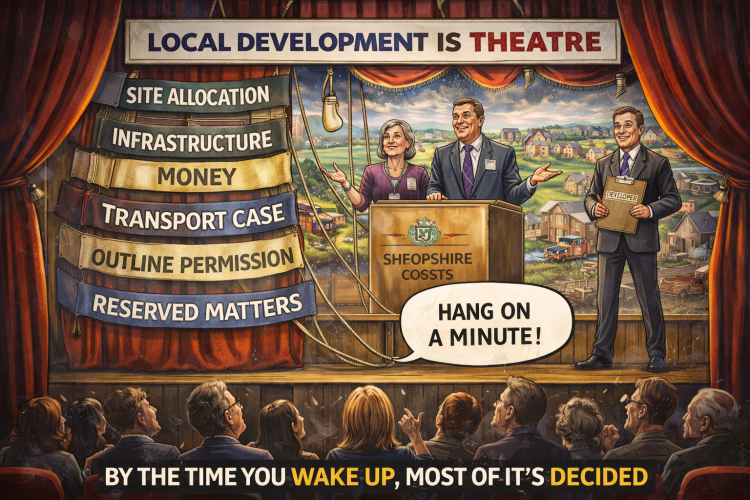
The public is encouraged to think of planning as a neutral balancing exercise, soberly administered by professionals and considered by elected members in the public interest. Yet the actual sequence looks very different. First comes the site allocation. Then the infrastructure money. Then the transport case. Then the outline permission. Then the reserved matters. Then the explanation that refusal is now difficult because the principle has long been established. By the time residents are fully awake to what “growth” means, the hard part has already been decided and the rest is theatre.
And in Oswestry, that theatre becomes especially hard to stomach
Because when a council-linked development vehicle benefits from the strategic planning environment, from public infrastructure upgrades, from the wider housing allocation framework, and from the same authority ecosystem that is supposed to regulate development impartially, people are entitled to ask whether the public interest is leading the process or merely being invited in at the end to admire the landscaping plan.
That is not nimbyism. That is not anti-growth hysteria. That is a perfectly rational response to a system in which the lines between promoter, enabler, overseer and beneficiary begin to blur so badly that only a fool or an officer writing a committee report could call it clean.
So yes, houses are being built. Many more are coming. Some will include affordable units. Some will bring Section 106 money. Some may even be decent enough places to live.
But that is not the only question
The real question is whether Shropshire still has a planning system designed to serve settled communities, or whether it now has a development culture designed to normalise expansion first and justify it afterwards.
Because from Oswestry to Shrewsbury, from Bridgnorth to Telford, the same pattern keeps appearing. A road is improved. A field is reclassified. A legal agreement is signed. A councillor says the right solemn words. A resident asks about traffic, schools, GP access or flooding. And somewhere in the background a developer, public or private, quietly counts the return.
Modern planning is no longer mainly about whether a place should grow
It is about making sure that by the time the public realises who the growth is really for, the diggers are already at the gate.
Postscript: if the public is not told clearly who this wave of housing is really for, they can hardly be blamed for suspecting it is not primarily for them. If these homes are truly being built to meet local needs, those in charge should have no difficulty saying so plainly – and proving it.

Just saying
 The Alternative Council