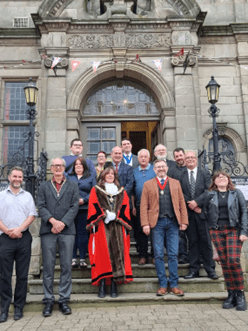
I thought it may be fun to look back at the defining moments of Oswestry’s political history.
How time flies when you are entangled by local government. Fifteen years after Oswestry’s old borough council was shovelled into the dustbin and unitary Shropshire took over, the town has seen Conservatives, Greens, Lib Dems and independents all take their turn at steering the civic wheel, or at least tugging at it. At every stage, residents have been promised prudence, progress, transparency and the other standard museum exhibits of municipal politics. What has actually emerged is a more revealing pattern: the periods of greatest stability often seem to have come when no one faction had the place entirely by the throat.
Conservatives’ Keeper (2009-2021)
For more than a decade, the Conservatives were the strongest branded force in Oswestry and wider Shropshire politics. They spoke the language of prudence, low tax and orderly management, with the confidence of bowlers in the Lords’ Pavilion. Road projects were announced, development was framed as opportunity, and public money was always said to be under sober stewardship. Yet even in that long stretch, Oswestry Town Council was not a one-party fiefdom for most of the time. It was mixed, messy and, for that very reason, often more restrained.
Between 2013 and 2017 in particular, the Town Council was plainly mixed. Conservatives, Lib Dems, Greens and independents or non-party councillors all had seats. In 2013 the returned council included 7 Conservatives, 3 Lib Dems, 1 Green and 7 independents or non-party councillors. In 2017 it remained mixed, with 9 Conservatives, 5 Greens, 3 independents and 1 unlabelled councillor. That is not ideological purity. It is a chamber where people at least had to look around the room before doing anything too clever.
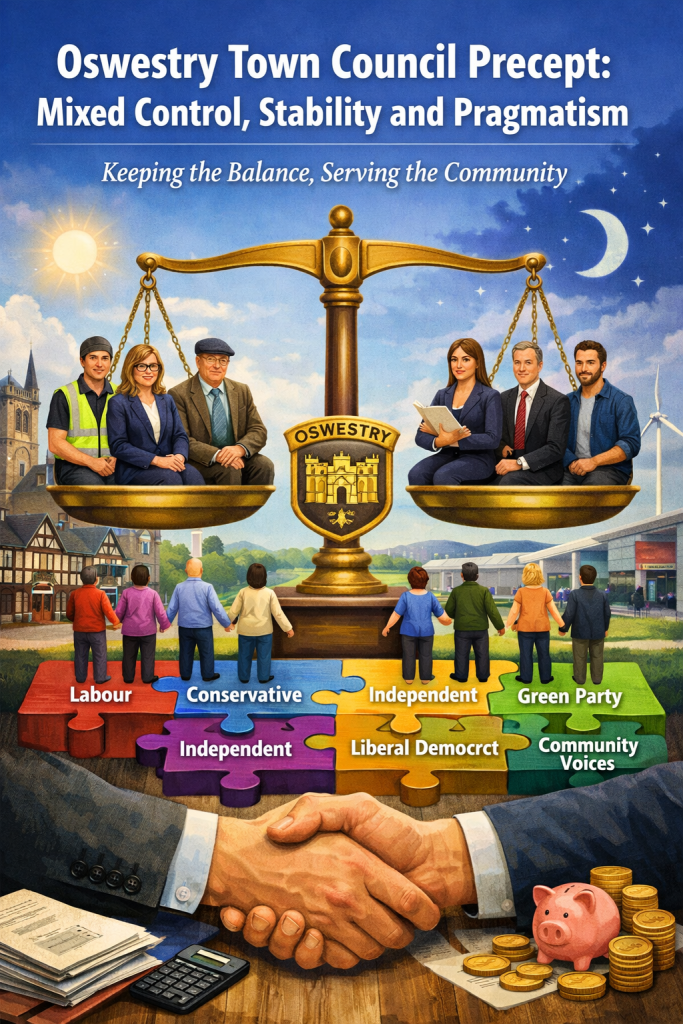
Oswestry Town Council Precept: Mixed Control, Stability and Pragmatism
The precept figures support the word stability. Oswestry Town’s Band D charge was £67.88 in 2013/14, £69.92 in 2014/15, £69.92 in 2015/16, £69.92 in 2016/17, £71.32 in 2017/18, £74.25 in 2018/19, £76.54 in 2019/20 and £78.05 in 2020/21, and £79.20 in 21/22, and £86.95 in 22/23, and £99.36 in 23/24, and £104.54 in 24/25, and,this is the kicker in 25/26 it is proposed to rise to £140 in 26/27. That is a gradual climb, not the sort of precept bungee jump that arrives later and is then dressed up as visionary leadership. On the face of it, that does look like a relatively restrained period.
That’s roughly a 75-80% rise in five years, ironically this rise occured when the Greens and LibDems formed a majority council. So much for looking after Oswestry’s residents.
That matters because it lends weight to the argument that the longest spell of relative precept stability came when no one party had complete control. Broadly speaking, the mixed-control era from 2009 to 2019, and certainly from 2013 to 2020, appears to have coincided with lower and steadier increases. This does not prove that mixed politics automatically produces wisdom. Human beings do enjoy mistaking correlation for divine revelation. But it is a credible inference that a politically mixed chamber encouraged a more pragmatic style of decision-making because no single faction could behave as though it had been appointed by God.
The Clerk at the time, David Preston, also fits that picture. Contemporary reporting shows him warning in early 2019 about risks to income, declining retail conditions, ageing properties and growing pressure on town councils to absorb services pushed down from Shropshire Council without matching funds. That is the language of caution and pragmatism, not ideological theatre. Under Preston, the administrative tone appears to have been one of careful husbandry rather than theatrical spending.
When you vote in the next local election, and I sincerely hope you do, think back over Oswestry’s political history and ask yourself a simple question: when was the town governed most sensibly? Under one party, or when several had to keep each other honest?
So the strongest fair conclusion is this: Oswestry’s longest spell of relative precept stability appears to have come when Conservatives, Greens, Lib Dems and independents all had to coexist. The result was not paralysis, as party machines so often warn, but something far more dangerous to them: pragmatism.
As sure as black-and-white photos, the Conservatives nonetheless touted their projects with gusto. The Innovation Park was celebrated, High Street Heritage funding was banked, and the Guildhall revamp was eventually paraded as evidence that prudent hands were on the tiller. Yet behind the rhetoric lurked the usual local-government irritants, from eyebrow-raising roads rows to the eternal difficulty of discovering who had decided what, and why.
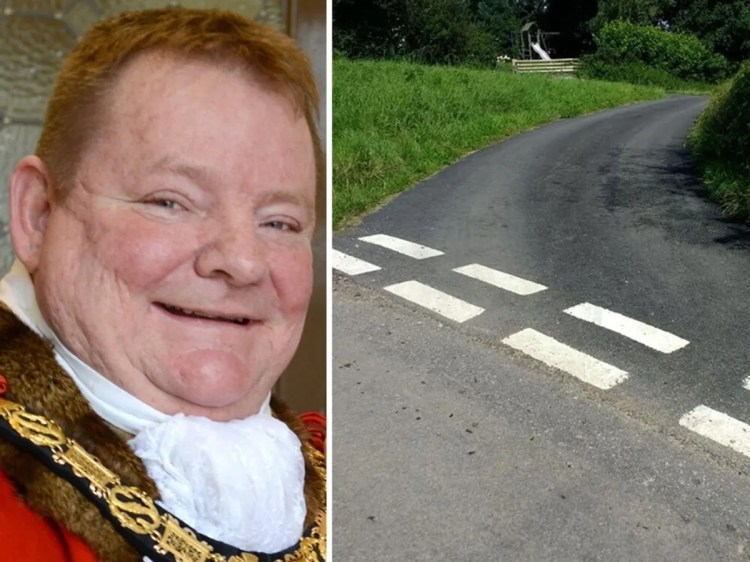
That wider Conservative-era story would be incomplete without a mention of former councillor Vince Hunt and the Shands Lane affair. Nothing says sober stewardship quite like a public row over more than £80,000 being spent resurfacing the lane serving Hunt’s home in Trefonen. Hunt and Joyce Barrow were later said by Shropshire Council officers to have done nothing wrong, but the episode still became one of those wonderfully Oswestry moments when the official explanation only deepened public suspicion. It was not simply about one road. It was about the old local-government problem of proximity, influence and the awkward optics that arise when public money appears to arrive with suspicious precision.
Even then, clerks and officers acted as the gears of the machine. They kept minutes, guarded inboxes and translated political ambition into paperwork. That may sound dull, but it often matters more than speeches in the chamber. A politically mixed council with a pragmatic clerk can sometimes deliver more restraint than a majority administration drunk on its own manifesto.
Greens and Glitters (2021-2024)
In May 2021, the village green sprouted a revolution. Oswestry’s electorate delivered 12 of the 18 Town Council seats to the Greens, making it one of the greenest councils in the country. Plastic bags, re-wilding, net-zero language and sustainability all strode onto the agenda with the confidence of people who had just discovered the town came with flowerbeds.

Mayor Duncan Kerr (The Only Green in the Village) promised to make Oswestry greener, cleaner and better. Plans were hatched for tree planting, cycle routes and an ambitious revision of the Oswestry Masterplan. The Heritage Action Zone money helped dress up the town’s historic fabric, because every era likes to imagine it is the one finally restoring dignity to the high street.
On Shropshire Council, two Greens unseated Tory incumbents in Oswestry South and West. Suddenly County Hall had eco-minded councillors demanding wildflowers, cleaner policies and a different tone from the old guard. Yet as anyone with houseplants knows, green thumbs must prune. The new council still faced limited money, practical constraints and the usual collision between worthy ambition and budget spreadsheets.
By the end of 2023, some of that green certainty had already begun to fray. Three councillors defected to the Lib Dems, citing Oswestry first rather than narrow party politics. Which is local government’s way of saying that principle had once again become highly portable.
Then came Oswestry Town Council’s 2024 fireworks fiasco, the sort of civic spectacle that manages to combine public entertainment with a post-event governance headache. The Cae Glas Park display on 2 November 2024 was meant to be a cheerful family occasion. Instead it generated complaints, questions over crowd management and exits, and the now familiar refrain that lessons would be learned once the smoke had cleared.
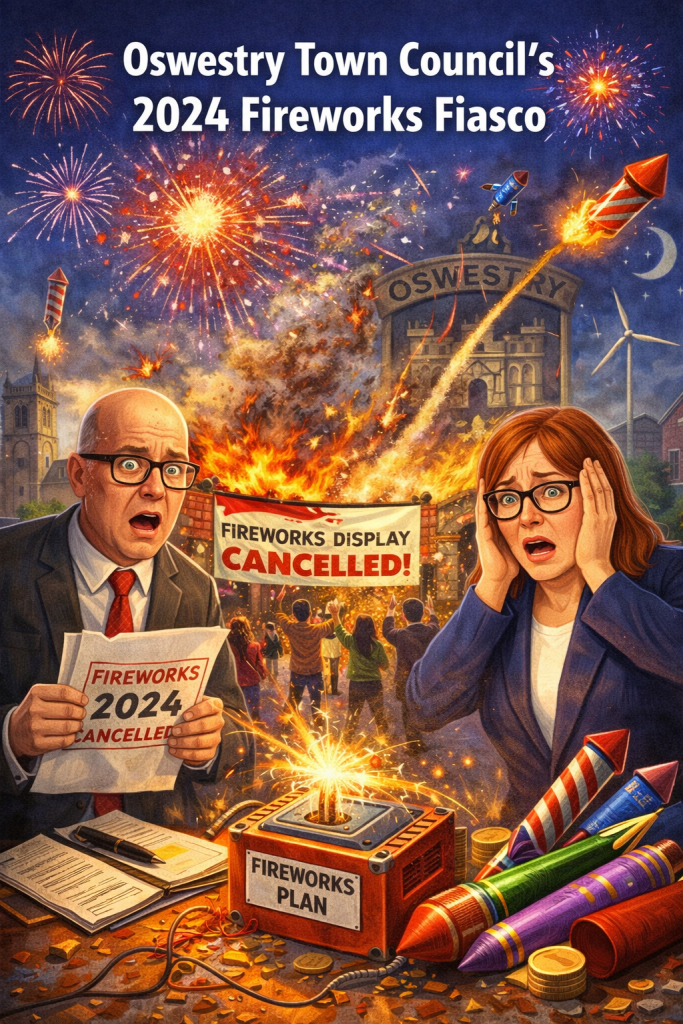
What made the episode so exquisitely Oswestry was the fog around oversight. The Safety Advisory Group was spoken of as though it were some reassuring guardian of competence, yet residents were left trying to work out whether any meaningful advice had actually been given. One account suggested an application for advice had been sent. Another indicated that no meeting had taken place. The result was not clarity but the usual local-government magic trick in which responsibility is everywhere in theory and nowhere in practice.
Under Mayor Mike Isherwood, the public response had all the hallmarks of modern municipal crisis management: an apology, a promise of review, mention of independent input, and no shortage of solemn language after the event. The real difficulty was not that a public event went wrong. These things happen. It was that even afterwards the town was still left peering through the cordite haze asking who planned what, who checked what and why straightforward answers were again treated like contraband.
Liberal Democrat Renaissance (2025-present)
The latest twist is Orange. May 2025 saw the Lib Dems break through into control of Shropshire Council, taking control and installing Heather Kidd as leader. The pitch was familiar enough: fix potholes, improve responsiveness, work better with town councils and present a cleaner, friendlier model of administration than the people before them.
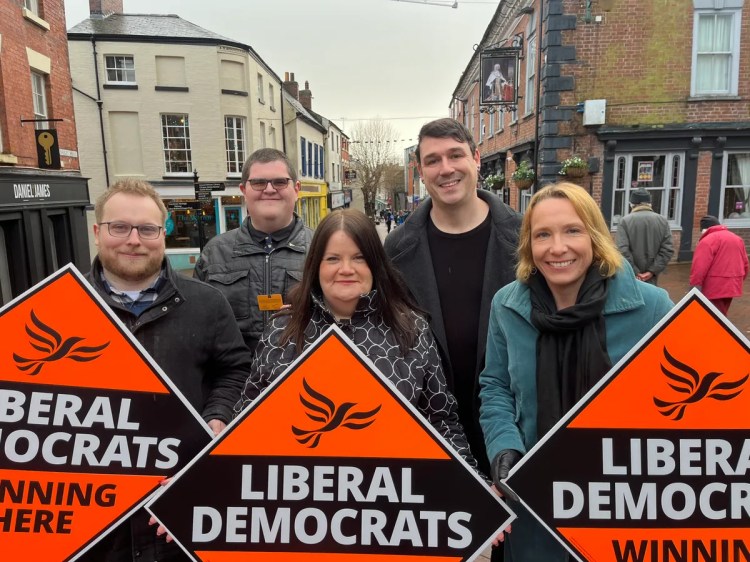
Oswestry Town Council felt the Lib Dem breeze earlier than that. James Owen won a by-election in late 2023, giving the Lib Dems a town foothold, and a few weeks later three sitting Greens announced they were switching to support Helen Morgan’s wider Liberal Democrat project. Helen Morgan hailed this as the first Lib Dem council group in Oswestry for nearly fifteen years. Which, translated from political celebration into plain English, means they had finally found a ladder back in.
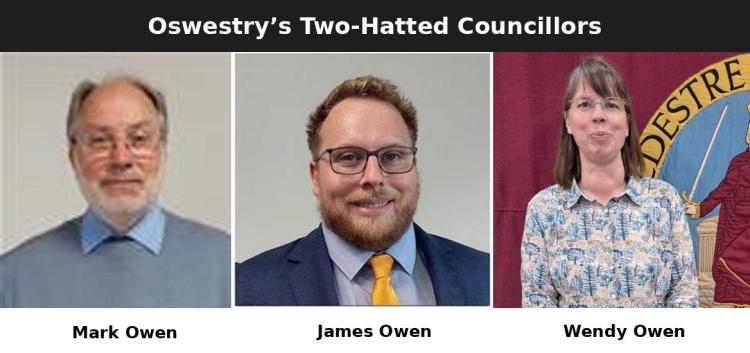
Then there is the Owen clan. Wendy, Mark and James Owen (with their two-hats) have all occupied prominent positions across town and county politics, giving critics ample material for muttering about dynasties, double-hatting and the remarkable concentration of one family around the levers of local decision-making. Whether you see that as public service or local government’s answer to a family franchise depends largely on whether you are related to them.
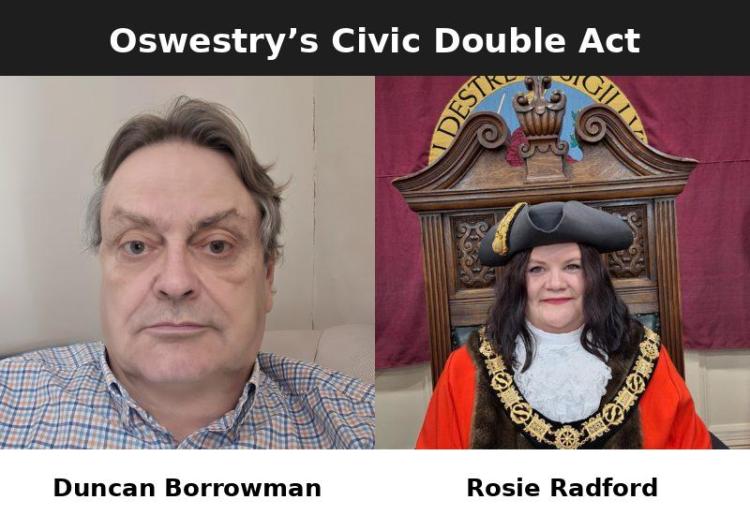
What cannot easily be dodged is the bill. The latest moves to devolve services to Oswestry Town Council without the money to go with them, together with a record-busting rise in Oswestry Town Council’s precept of 39% and a steep increase in Shropshire Council’s own charge of 9%, have made the politics of partnership rather less charming when viewed through a household budget.
Which hat were they wearing when that was voted through?
Clerks & Gatekeepers
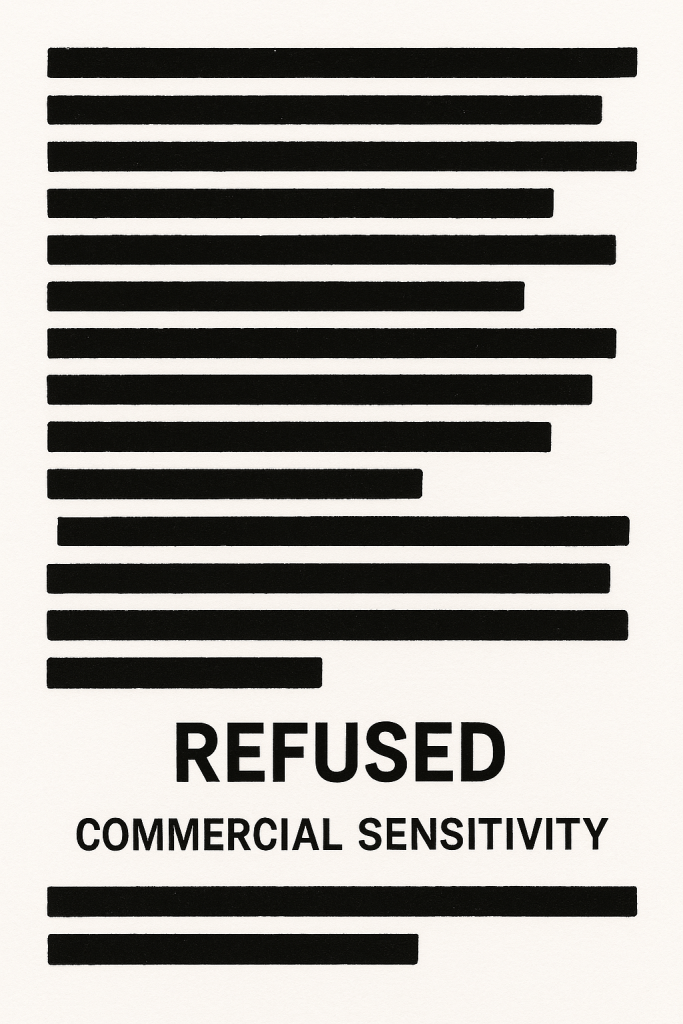
Amid all these party frolics, clerks and officers remain the permanent machinery. Officially they are apolitical facilitators, the sinews of local government. In practice they are also the gatekeepers of access, speed, tone and occasionally silence. Anyone trying to get awkward questions in front of councillors quickly discovers that correspondence does not always travel freely.
That matters because democracy in a town like Oswestry does not depend only on who wins elections. It also depends on whether information flows, whether awkward questions are allowed to breathe and whether residents can get a straight answer before the issue has grown old, smoky and conveniently procedural. The epitome of this is the current incumbent who, when he’s not working from home, scuttles around the Guildhall like a demented rodent.
Conclusion
Taken together, the two drafts point to a simple and rather awkward truth. Oswestry’s more stable years appear to have come not when one party dominated the chamber, but when different political instincts had to coexist and compromise. The mixed era was not glamorous. It was not ideologically pure. It simply seems to have been steadier, cheaper and more pragmatic.
Since then, the town has had a Green surge, Lib Dem realignment, fireworks controversy, service devolution anxieties and the modern local-government obsession with promising transparency while treating straightforward answers like contraband. As always, much is promised, little is simple and the public is expected to admire the pageant while footing the bill.
If there is a lesson in Oswestry’s recent civic history, it is that plurality may be untidy but it can also be healthy. A council forced to negotiate internally may prove less reckless than one convinced it has discovered virtue in permanent office. Which is an unfashionable conclusion in politics, but then so is common sense.
And finally
When you vote in the next local election — and I sincerely hope you do — think back over Oswestry’s political history and ask yourself a simple question: when did the town function best?
Under the Conservatives, the Greens, or the Liberal Democrats?
The uncomfortable answer may be that it worked best when none of them were in charge on their own.
Before I forget, whatever happened to these? Free access to a council meeting if you can locate them.


Mysteriously missing after being paid for by Council grants.
 The Alternative Council