
At yesterday’s Shropshire Council meeting, a question from a member of the public, Andrew Sceats cut through several years of carefully managed explanation surrounding Cornovii Developments Ltd.
Mr Sceats asked why many residents had been left with the impression that Shropshire Council would receive financial returns from Cornovii not only through land sales, but also through profits generated by the houses the company builds and sells. He further questioned whether, after five years of operation, directors’ fees and related expenditure may have benefitted individuals more than the Council itself.
The response came from Councillor James Owen, Portfolio Holder for Housing & Leisure, who explained that Cornovii was never intended to provide immediate financial returns. Instead, he said, it was designed as a long-term strategic vehicle delivering housing and regeneration outcomes, with financial benefits expected only over time.
It was a calm and carefully worded answer.
It was also revealing.
Because it raises a more important question than the one originally asked.
If Cornovii’s long-term nature was always understood, who exactly was supervising its progress over the past five years?
The Promise in 2019
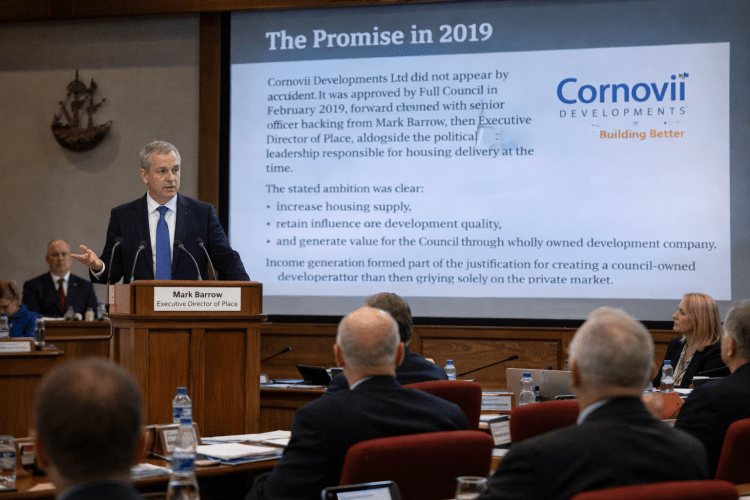
Cornovii Developments Ltd did not appear by accident. It was approved by Full Council in February 2019, brought forward with senior officer backing from Mark Barrow, then Executive Director of Place, alongside the political leadership responsible for housing delivery at the time.
The stated ambition was clear:
• increase housing supply,
• retain influence over development quality,
• and generate value for the Council through a wholly owned development company.
Income generation formed part of the justification for creating a council-owned developer rather than relying solely on the private market.
The Housing Supervisory Board
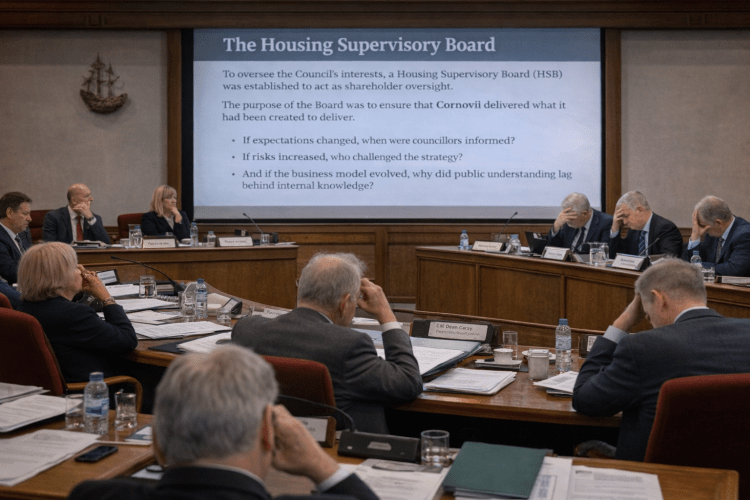
To oversee the Council’s interests, a Housing Supervisory Board (HSB) was established to act as shareholder oversight.
The purpose of the Board was to ensure that Cornovii delivered what it had been created to deliver. If expectations changed, when were councillors informed? If risks increased, who challenged the strategy? And if the business model evolved, why did public understanding lag behind internal knowledge?
The Directors of Cornovii Developments Ltd
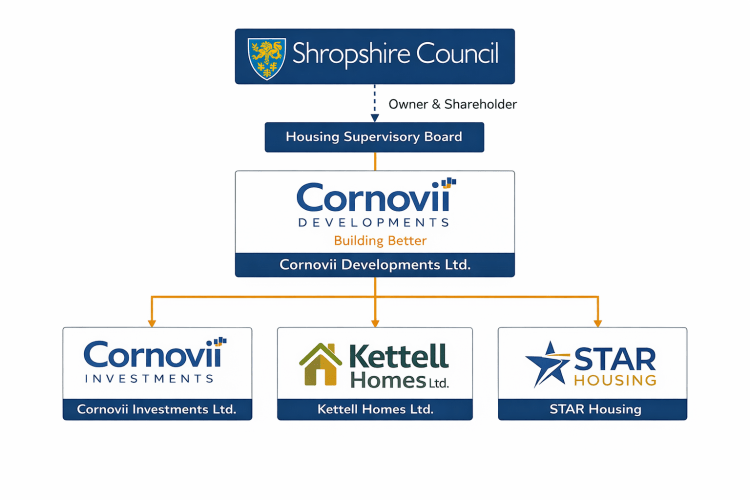
Cornovii is a company governed by named directors operating under the Companies Act. These roles carry legal duties to promote the success of the company while operating within a structure where the shareholder, lender and strategic authority are effectively the same organisation: Shropshire Council.
Development risk is financial, immediate and ultimately borne by taxpayers.
Where Does the Money Actually Go?
To understand why homes can be sold without money returning to Council coffers, it helps to follow the journey of the cash itself.
The Cornovii and Kettell Homes Cash Journey
Introduction
The existence of Kettell Homes helps explain why many residents assumed Cornovii was generating profits for Shropshire Council. Houses were clearly being marketed and sold. Sales boards appeared. Developments completed. Buyers moved in.
From the outside, it looked like a successful housebuilder.
The financial journey, however, is considerably more complicated.
Stage 1: The Starting Point – Council Assets
The process begins not with a private investor, but with public resources.
Shropshire Council provides:
• development land owned by the authority; and
• loan finance funded through council borrowing.
In some cases land is sold for cash. In others, land value is converted into equity shares within Cornovii Developments Ltd rather than immediate payment to the Council.
At this point, public assets have already moved into the company structure.
Stage 2: Funding the Build
Cornovii then operates as developer, funding construction through:
• council loans,
• development finance arrangements,
• and project borrowing secured against future sales.
Interest accrues on these loans. Build costs, professional fees, infrastructure works and market risks all sit inside the company accounts.
Before a single property is sold, significant costs must be recovered.
Stage 3: Enter Kettell Homes

Completed properties are marketed and sold under the Kettell Homes brand.
To buyers, this appears indistinguishable from a conventional private developer. Contracts are signed, homes are sold, and sale proceeds are received.
This is the moment most observers assume profit is being made. But sales income does not travel directly back to the Council.
Stage 4: The First Call on Sale Proceeds
Money from house sales is absorbed internally to cover:
1. Construction costs
2. Professional and operational expenses
3. Interest payments on council loans
4. Repayment of development borrowing
5. Recovery of earlier project deficits
Only after these obligations are met can the company show distributable profit.
Stage 5: The Balance Sheet Reality
Even where developments complete successfully, accumulated borrowing and early losses may mean shareholder funds remain in deficit.
Until the company moves into surplus:
• no dividends can legally be paid;
• and the Council receives no direct financial return beyond loan interest or accounting adjustments.
Homes may be selling, yet cash does not flow back to council reserves.
Stage 6: The Long-Term Promise
The model relies on a future tipping point.
Once enough schemes are completed and historic deficits recovered, profits may eventually emerge and dividends could be paid to the Council as shareholder.
That moment, however, sits somewhere in the future rather than the present.
A conventional private developer typically builds through a single-purpose company, sells the completed homes, repays borrowing, extracts profit and then winds the company up. The objective is immediate financial return. The Cornovii structure, by contrast, appears designed to retain assets and defer returns into the future.
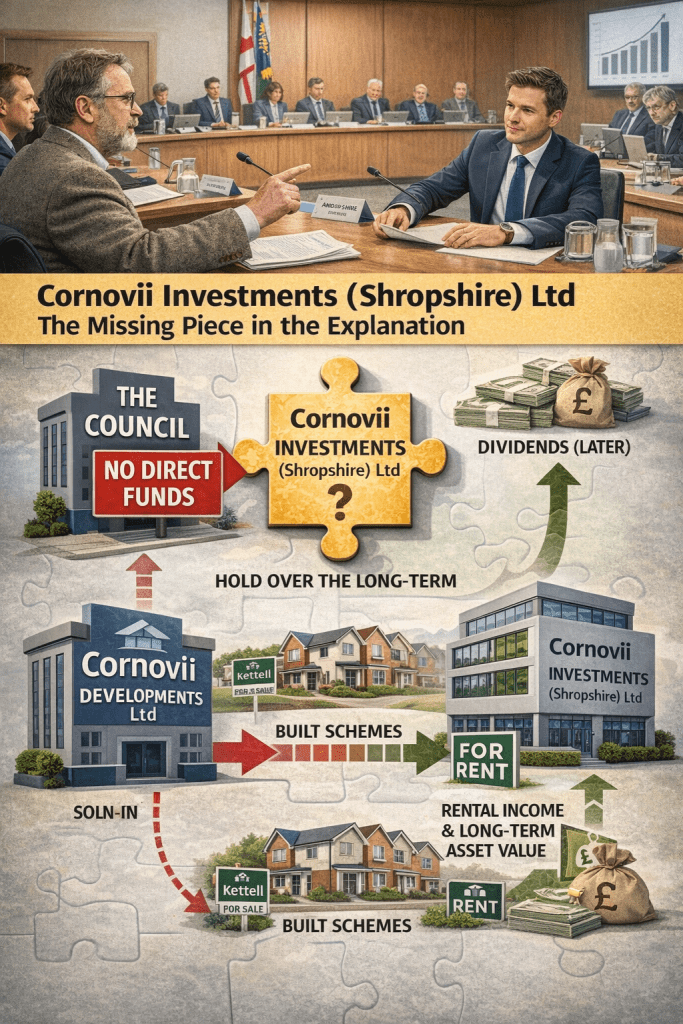
Cornovii Investments (Shropshire) Ltd: The Missing Piece in the Explanation
During the Council meeting, Andrew Sceats asked a question that went to the heart of public confusion. He stated that he had been informed the only capital receipts received by the Council were linked to land transactions, and that no income had yet flowed from profits generated by the sale of homes. He questioned whether, after five years of operation, directors’ costs and related expenditure may already exceed any financial benefit returned to the authority.
In response, Councillor James Owen explained that Cornovii Developments Ltd had never been intended to generate immediate financial returns. Instead, he described a long-term strategic model in which benefits to the Council would arise over time, once the company had recovered earlier deficits and reached a surplus position capable of supporting dividends.
What was not fully visible within that exchange is the role played by a second company within the structure: Cornovii Investments (Shropshire) Ltd.
While Cornovii Developments Ltd builds schemes, Cornovii Investments (Shropshire) Ltd exists to hold assets over the long term. Properties delivered through development are not always sold on the open market. Some may instead transfer into the investment company, where value moves from cash into property ownership.
This distinction is critical.
When a home is sold through the Kettell Homes brand, observers naturally expect money to flow back to the Council. But where properties are retained within Cornovii Investments (Shropshire) Ltd, no immediate receipt is created. The anticipated benefit becomes future rental income or long-term asset value rather than present-day cash.
In that context, Councillor Owen’s description of a “long-term strategic return” becomes easier to understand. The model relies not simply on building and selling homes, but on accumulating property assets whose financial value may only emerge years later.
The difficulty is that this layered structure was never widely understood outside council governance circles. To residents watching developments being completed and occupied, the absence of visible financial return appears puzzling. Yet within the group structure, the money has not vanished. It has changed form.
Cash has become property.
And that transformation lies at the centre of the continuing debate about whether expectations surrounding Cornovii were ever clearly explained.
If the financial model depended on multiple companies operating together, the obvious question becomes who, exactly, was responsible for ensuring councillors and the public understood it.
Why This Matters
The structure itself is not unusual. What is unusual is how poorly it appears to have been explained.
What matters is understanding the difference between visible activity and financial outcome.
Kettell Homes shows houses being sold.
Cornovii’s accounts determine whether money actually returns to the public purse.
Between those two points lies the gap that has caused years of confusion.
From Expected Returns to ‘Long‑Term Strategy’
Councillor Owen acknowledged that clearer communication could have been provided regarding the timing and nature of financial returns.
In 2019, Cornovii was widely understood as a vehicle capable of delivering homes and income. In 2026, it is described primarily as a long‑term strategic investment whose financial benefits remain somewhere in the future.
Governance or Theatre?
Five years into operation:
• dividends have not materialised,
• land value has in part been converted into equity rather than cash,
• and the Council continues to carry exposure through loans and committed assets.
None of this is automatically wrongdoing. But it does demand accountability.
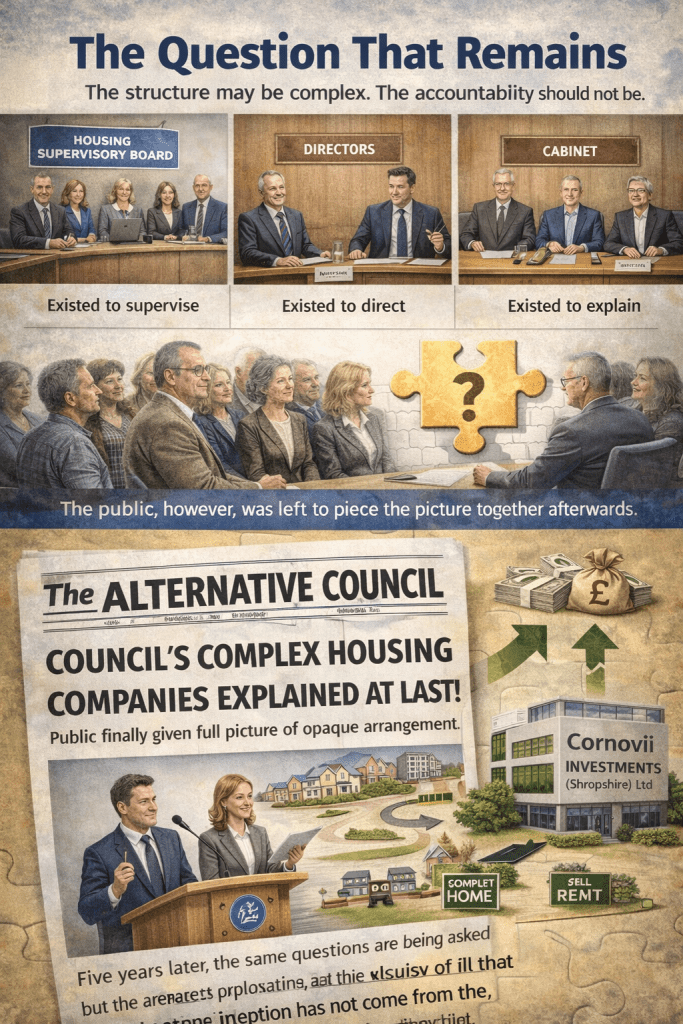
The Question That Remains: The structure may be complex. The accountability should not be.
Cornovii may yet deliver long-term benefits. That possibility remains open.
The Housing Supervisory Board existed to supervise.
The directors existed to direct.
Cabinet existed to explain.
The public, however, was left to piece the picture together afterwards.
Five years later, the same questions are being asked but the answers are just as elusive.
It is perhaps the greatest irony of all that the clearest explanation has not come from the Council itself, but from The Alternative Council.
Now, readers, I think it is time to share with you the names of the people involved in this “project”.
Governance and Oversight Structure – Cornovii Developments Ltd
Housing Supervisory Board (Shareholder Oversight)
The Housing Supervisory Board was established by Shropshire Council to exercise shareholder oversight of Cornovii Developments Ltd on behalf of the authority. Its stated function included monitoring performance, reviewing business plans, and ensuring delivery aligned with Council objectives.
Membership (as recorded in Council reports and minutes)
| Name | Position |
|---|---|
| Rosemary Dartnall | Councillor |
| Everley Waite | Councillor |
| Brian Evans | Councillor |
| Harry Hancock-Davies | Councillor |
| Nigel Lumby | Councillor |
| Mark Owen | Councillor |
| Vivienne Parry | Councillor |
| Jon Tandy | Councillor |
| Elizabeth Barker | Councillor (Substitute) |
| Ed Bird | Councillor (Substitute) |
| Jamie Daniels | Councillor (Substitute) |
| Rhys Grafton | Councillor (Substitute) |
| George Hollyhead | Councillor (Substitute) |
| Alan Mosley | Councillor (Substitute) |
| Colin Taylor | Councillor (Substitute) |
| Teri Tricket | Councillor (Substitute) |
Responsibilities included review of company performance, financial monitoring, and reporting back through Council governance structures.
Support Officer
Shelley Davies. Committee Officer
Cornovii Developments Ltd – Company Directors
Cornovii Developments Ltd operates as a wholly owned Council company. Directors hold statutory duties under the Companies Act 2006 to promote the success of the company and exercise independent judgement.
Emily Swinnerton
David Baker
Richard Ian Cambray
Cllr Mark Owen
Chris Poulton
Timothy John Pritchard
Harpreet Rayet
Governance Context
- Shropshire Council is sole shareholder.
- The Council has also acted as lender and land provider to the company.
- Financial returns to the Council are dependent on company profitability and shareholder surplus.
- Oversight was exercised through Cabinet, the Housing Supervisory Board, and audit arrangements.
Why may you ask? Because Cornovii Developments builds the houses. Cornovii Investments exists to keep hold of the value after they are built. And notably, accumulated borrowing remains within Cornovii Developments Ltd rather than the entity holding long-term assets.
And so, dear readers, this is the point where you realise you are no longer looking at a housing project, but at a council-owned property group dressed in municipal clothing.
Cornovii Investments (Shropshire) Ltd – Company Directors
Harpreet Rayet
Timothy John Pritchard
Christopher John Poulton
Richard Ian Cambray
Emily Swinnerton Secretary
Rosamond Frances Bridges Secretary
Shropshire Towns and Rural Housing Ltd
Richard Burgess Amos
Anthony William Deakin
Lynn Joyce Fonseca
Paul Hayward
Kathy Jones
Cllr Duncan Kerr
Rebecca Claire Royle
Irin Wood
I’m sure that any of the above would be more than happy to answer any questions you may have.
 The Alternative Council