How Decisions You Never Saw Became Bills You Cannot Avoid
This is not an insider discussion. It is not a conversation for those already steeped in council papers and committee minutes.
This is about understanding how decisions made quietly over years eventually arrive as very visible costs for residents.
What follows is not theory. It is a trail of decisions, evidence and outcomes that connect directly to what people are now being asked to pay.
Growth Without Planning
Shropshire is not suffering from a housing strategy. It is suffering from housing momentum.
Developments appear, permissions are granted, and the machinery rolls forward while roads, schools and utilities trail somewhere behind asking what just happened.
Residents are told this is progress. The lived experience feels closer to improvisation.
The promise is always the same: infrastructure will follow. The reality is equally familiar: it rarely does.
Planning once meant shaping growth. Increasingly, it resembles approving consequences first and asking questions later.
The Money Problem Everyone Pretends Is Complicated
The financial position is not mysterious. Councils expanded commitments while hoping tomorrow’s funding would repair yesterday’s decisions.
Reserves fall. Borrowing rises. Committees multiply.
Households facing the same situation would cut costs and prioritise essentials. Local government produces another strategy document and calls it stability.
The gap between explanation and reality grows wider each year.
Oswestry: Where Theory Meets Your Council Tax Bill
A substantial precept increase has been presented as unavoidable necessity rather than political choice.
But budgets do not pass themselves. Votes are cast. Decisions are owned.
And this is where the story stops being abstract.
Two-Hatted Councillors: The Convenient Arrangement
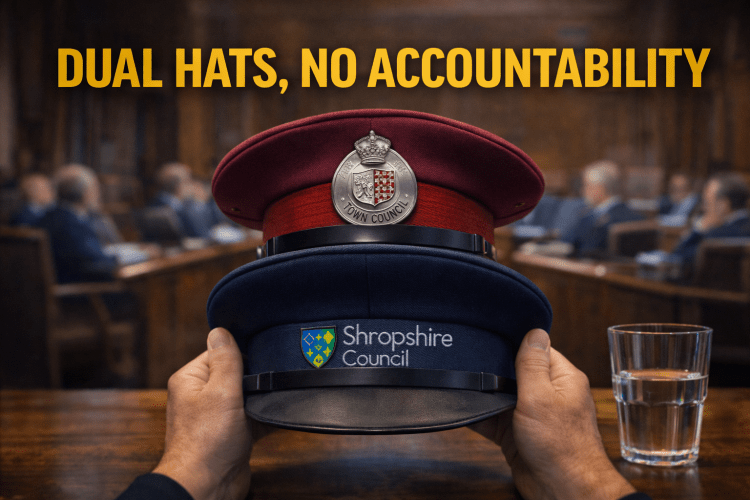
Two-hatting is legal. Clarity, however, becomes harder to locate.
A councillor may help shape pressures at one authority and later explain those same pressures at another.
Cause and consequence separated only by a different meeting agenda.
When the Oswestry budget was pushed through, residents were not watching isolated local decision-making. They were watching a system voting on outcomes partly created within itself.
No rules broken. Just a remarkable absence of distance.
The public is asked to believe roles exist in isolation. That influence never travels between rooms. That institutional loyalty never colours judgement.
It is a reassuring idea. It is also difficult to sustain.
Example: What Two Hats Look Like in Practice

When the consequences of those wider policies filter down to town level, including financial pressures and local budget decisions, the same individual may also participate in discussions affecting residents directly.
Councillor James Owen, Cabinet Member for Housing & Leisure at Shropshire Council, provides a clear illustration of how two-hatting operates in reality.
In his cabinet role, housing policy, development strategy and wider financial pressures connected to housing delivery form part of the decision‑making environment.
No rule prevents this arrangement. The issue is not legality but perception and accountability.
For residents, it can become difficult to distinguish where county‑level policy ends and local representation begins.
The question therefore is not whether the roles are permitted, but whether voters can clearly see which responsibility is being exercised at any given moment.
The Question Nobody Answers
Democracy weakens when accountability becomes blurred.
Were councillors voting purely as local representatives, or defending decisions already shaped elsewhere?
Which hat was being worn? And whose interests travelled with it?
Enter Cornovii: The Council’s Property Experiment
If financial pressure has a starting point, Cornovii Developments Ltd sits close to it.
Created to deliver homes and generate income, the company promised long-term financial benefit for taxpayers.

The theory was simple: build, sell, profit, reinvest.
The accounts tell a different story.
Year after year, profits fail to appear. Losses or negligible returns persist. Exposure increases while the expected dividend remains absent.
When income fails to materialise, risk does not disappear. It moves.
And ultimately, it moves back toward the taxpayer.
Risk Without Visibility
Cornovii operates administratively at arm’s length, but financially it remains tied to the council.
Loans originate from public funds. Land involves public assets. Decisions made within the authority shape the company’s direction.
Losses sit quietly in company accounts. Pressure reappears later in council budgets.
By the time residents notice, it arrives labelled as necessity.
The Elephant Is Still in the Room
For years, questions about Cornovii have lingered without clear answers.
The structure is complex. Reporting is opaque. Scrutiny is often treated as inconvenience.
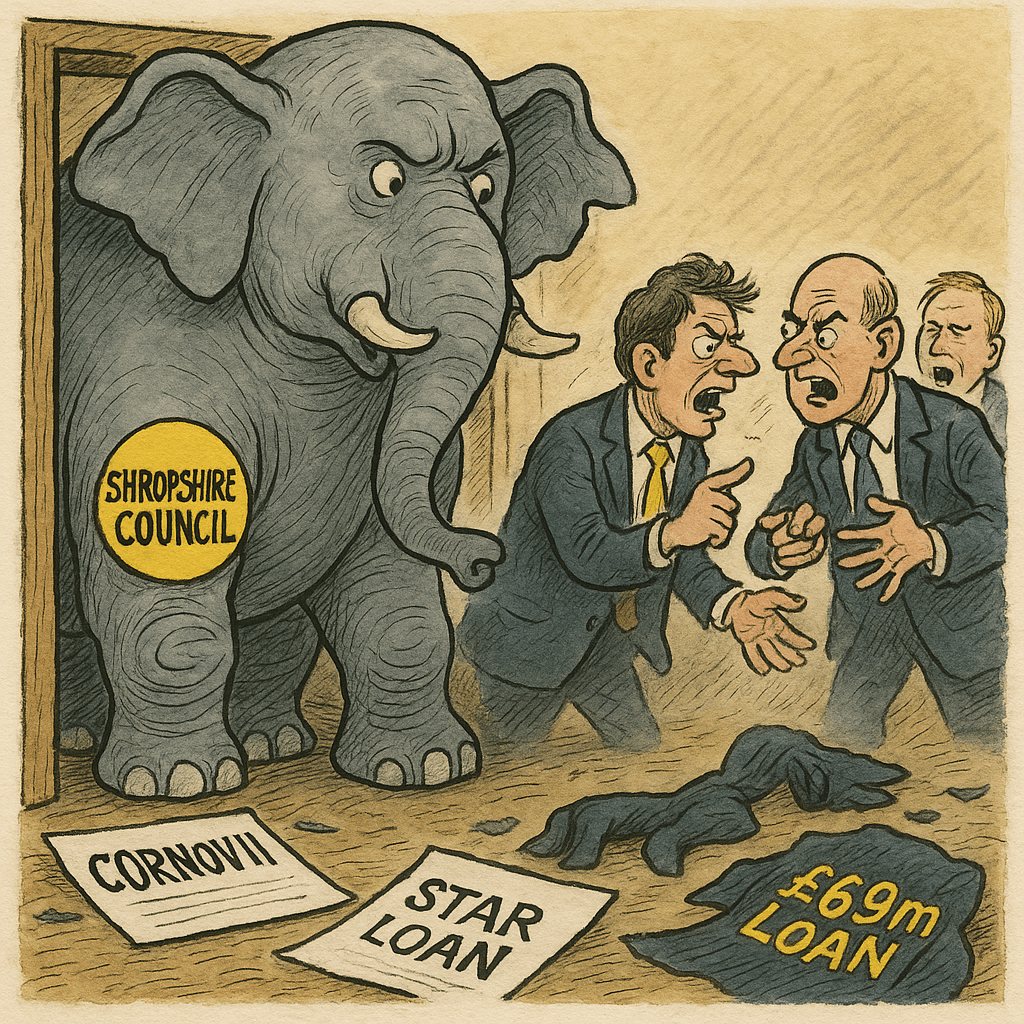
The elephant has never left. Attention has simply been directed elsewhere.
When taxes rise and services tighten, residents are entitled to ask whether today’s pressures are the delayed result of yesterday’s experiments.
Once Cornovii is acknowledged, the debate changes.
This stops being a local budgeting issue and becomes a question of risk, oversight and accountability.
Why This Matters to Oswestry
By the time decisions reach a Town Council chamber, most of the real choices have already been made elsewhere.
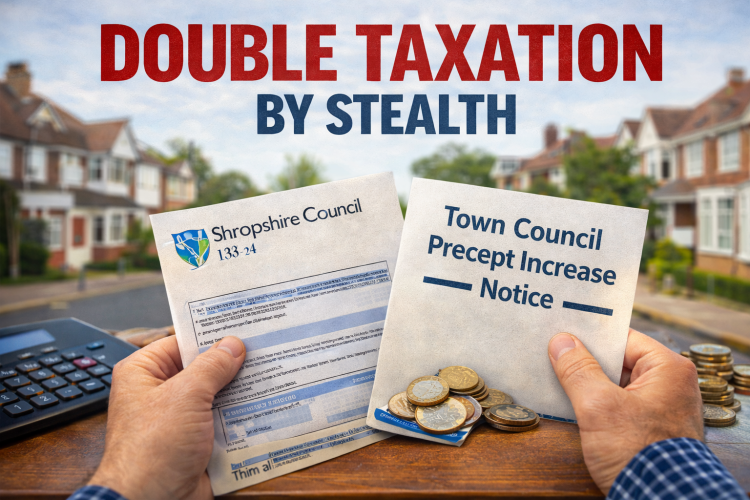
Policies have been shaped. Risks have been taken. Financial commitments have quietly accumulated. What remains locally is not strategy, but consequence.
Two-hatted councillors sit at the point where those consequences finally meet the public. They may not have created every pressure now facing residents, but they are part of the system that carried those pressures here.
And that is where the discomfort begins.
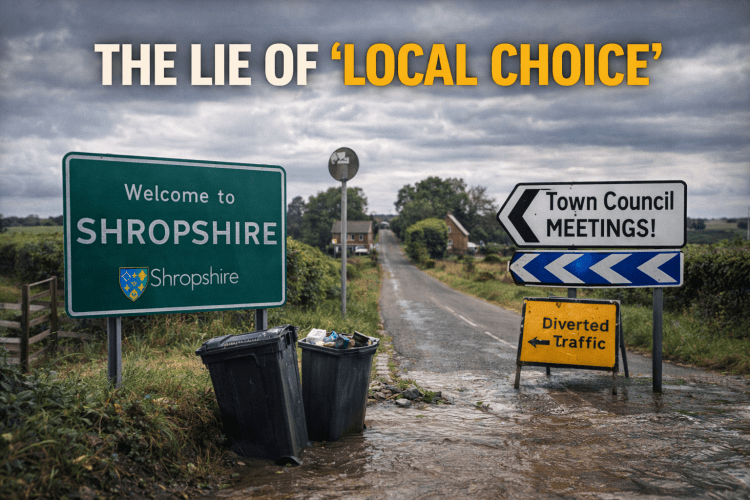
Because when council tax rises are described as unavoidable, residents are entitled to ask unavoidable questions in return.
Unavoidable by whom?
Unavoidable since when?
Unavoidable because of necessity… or because earlier decisions cannot now be undone?
Cornovii was meant to ease financial strain. Instead, the strain remains.
Planning was meant to shape growth. Instead, growth shapes communities after the fact.
Representation was meant to provide distance between decision-makers and consequences. Instead, the same names appear on both sides of the table.
The elephant is not hiding anymore.
It is standing in plain sight, stamped with public money, public risk, and public accountability.
And sooner or later, someone has to decide whether it will finally be addressed…
or simply fed again.
 The Alternative Council