
Architects Gone, Liabilities Remain
There comes a point in any local controversy where the reader stops nodding politely and starts checking whether the page is upside down.
This is that point.
Because once the structure is laid out in full, even the most charitable observer is entitled to pause, rub their eyes, and say:
“That can’t possibly be how this is meant to work.”
And yet — here we are.
At the centre of Shropshire Council’s property strategy sits Cornovii Developments Ltd.
This is not a partner. Not a joint venture. Not an “arm’s length” arrangement, despite that phrase being deployed with the soothing regularity of a lullaby.
Cornovii Developments Ltd is owned by Shropshire Council.
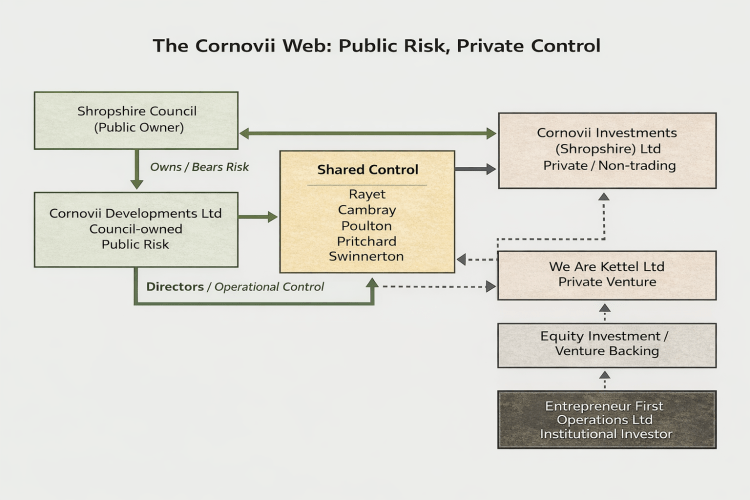
Which means, in plain English:
the Council owns it,
the Council carries the risk,
and the public carries the consequences.
This is not politics.
It is arithmetic.
Running this council-owned company is a board of directors.
They manage the company, but they do not own it.
Ownership — and therefore ultimate exposure — remains firmly with the taxpayer.
Now look just slightly to the side.
Alongside Cornovii Developments Ltd sits Cornovii Investments (Shropshire) Ltd.
A separate company.
Non-trading.
Not owned by the Council.
Owned privately.
And who owns it?
Predominantly, the same individuals who sit on the board of the council-owned company.
So, to summarise:
• A publicly owned operating company carrying public risk
• A privately owned, non-trading company
• Controlled by largely the same people – and we all know how that is going to work out.
All perfectly visible on the public record.
All perfectly absent from reassuring summaries.
At this stage, readers may reasonably wonder what possible problem this elegant complexity is solving, other than the inconvenience of clarity.
Elsewhere in this carefully curated ecosystem sits We Are Kettel Ltd.
We Are Kettel Ltd is often described using the language of innovation, modernity, and clever new routes into home ownership.
It is also backed by Entrepreneur First Operations Limited, a professional venture accelerator with institutional discipline and clear commercial incentives.
That is not, in itself, a criticism.
It is context.
What follows, however, is not optional context.
It is critical.
We Are Kettel Ltd is not authorised or registered by the Financial Conduct Authority.
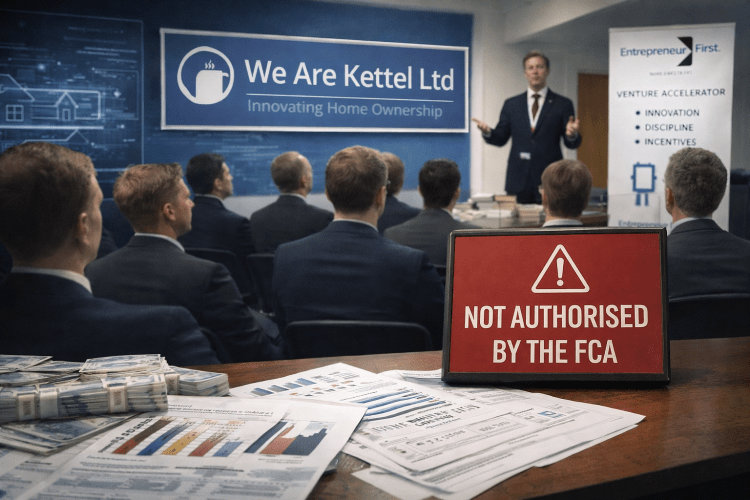
That single sentence has consequences.
An FCA-authorised firm is bound by strict rules:
it must give suitable advice,
it must disclose risk clearly,
it must manage conflicts of interest,
and it must put the customer’s interests first.
If an FCA-authorised firm gives bad financial advice, the consumer has protections.
They can complain.
They can escalate.
The Financial Ombudsman can intervene.
Compensation may be available.
None of that applies here.
A company that is not FCA-authorised cannot lawfully provide regulated financial advice.
If it nevertheless discusses affordability, funding routes, or “innovative” ways into home ownership, the individual receiving that guidance carries the risk alone.
If it goes wrong: there is no regulator to intervene, no ombudsman to complain to,
no guaranteed route to redress, and no safety net.
The homeowner is on their own.
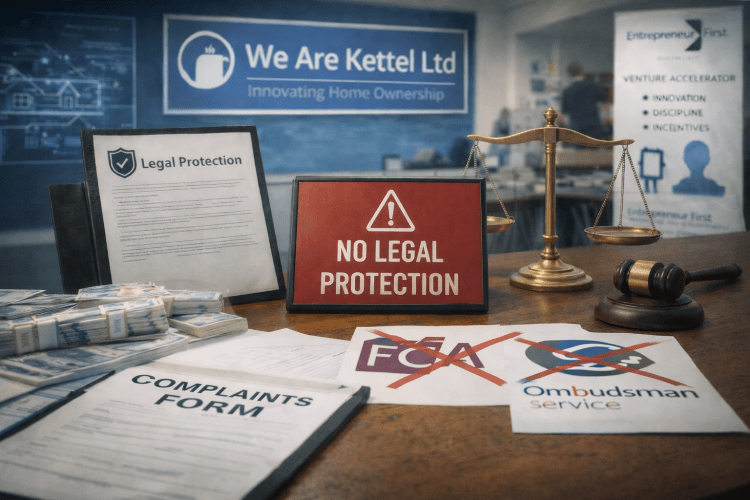
In practical terms, this means that if a resident makes a catastrophic financial decision
based on guidance they reasonably believed to be credible,
the consequences do not stop at disappointment.
They can include:
loss of savings,
unsustainable debt,
mortgage distress,
and, in the worst cases, loss of the home itself.
And when that happens, responsibility has a habit of evaporating.
The company will say it offered “information, not advice”.
Public bodies will say they were not responsible.
The individual will discover, too late, that the protections they assumed existed never did.
In a housing ecosystem already defined by complexity, blurred accountability, and carefully displaced risk, this is not a technical oversight.
It is a material exposure.
And then there is the small matter of who designed all this.
The Cornovii structure did not assemble itself spontaneously.
It was designed.
It was promoted.
It was defended.
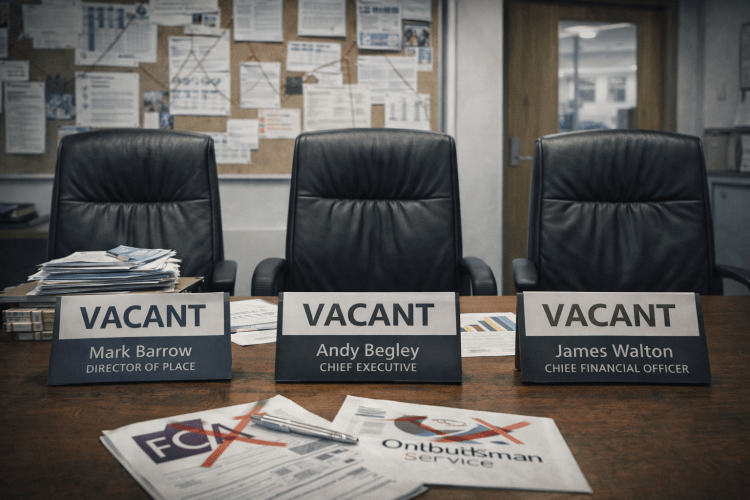
By senior officers of Shropshire Council.
Mark Barrow, then Director of Place.
Andy Begley, then Chief Executive.
James Walton, then Chief Financial Officer.
These were the architects.
The people paid to understand governance, risk, and accountability.
The people who assured members that this arrangement was sensible, safe, and “robust”.
And now?
They have all gone.
No final explanations.
No public reckoning.
No awkward walk-through of how public risk came to be wrapped in such elaborate organisational origami.
One might call this coincidence.
One might also note that it is an exceptionally well-timed coincidence.
So let us be absolutely clear about where responsibility now sits.
The officers who designed this structure have departed.
The paperwork remains.
The risk remains.
The consequences remain.
The architects are gone.
The liabilities are not.
I See This as an Opportunity

There is, buried beneath the wreckage, a genuine opportunity here. None of the officers who designed this structure have yet been replaced. The seats are empty. The carousel is paused. And that creates a moment of choice. Instead of reflexively restocking the senior posts from the familiar circuit of career officers who depart one authority to “spend more time with their family” or to “seek new challenges” usually somewhere with a larger budget and fewer questions, the Council could try something genuinely radical: lateral thinking. That would mean appointing people who have actually succeeded in the private sector, where risk is real, failure is personal, balance sheets matter, and accountability does not dissolve into a committee paper. People who understand that complexity is not a virtue in itself, that exposure must be owned, and that structures which cannot be explained plainly are usually designed that way for a reason. It would be a break from habit. It would also be an admission that what passed for expertise before was not expertise at all, merely familiarity dressed up as reassurance.
Which leaves only one unanswered question:
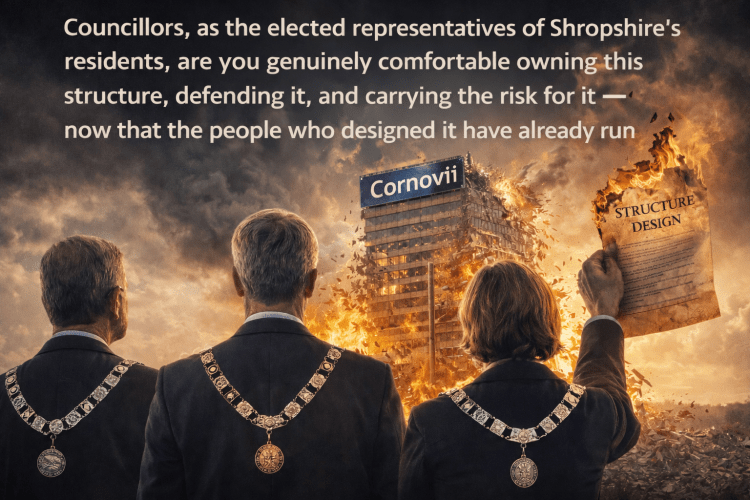
Councillors, as the elected representatives of Shropshire’s residents,
are you genuinely comfortable owning this structure, defending it,
and carrying the risk for it — now that the people who designed it have already run for the exits?
 The Alternative Council