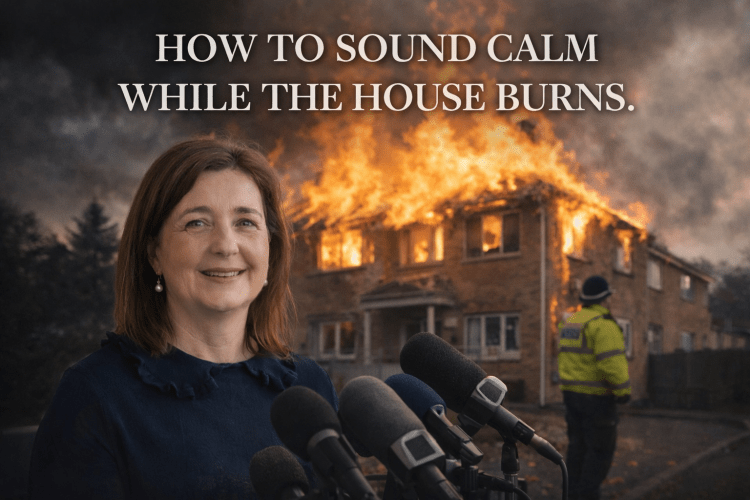
(OR: HOW TO SOUND CALM WHILE THE HOUSE BURNS)
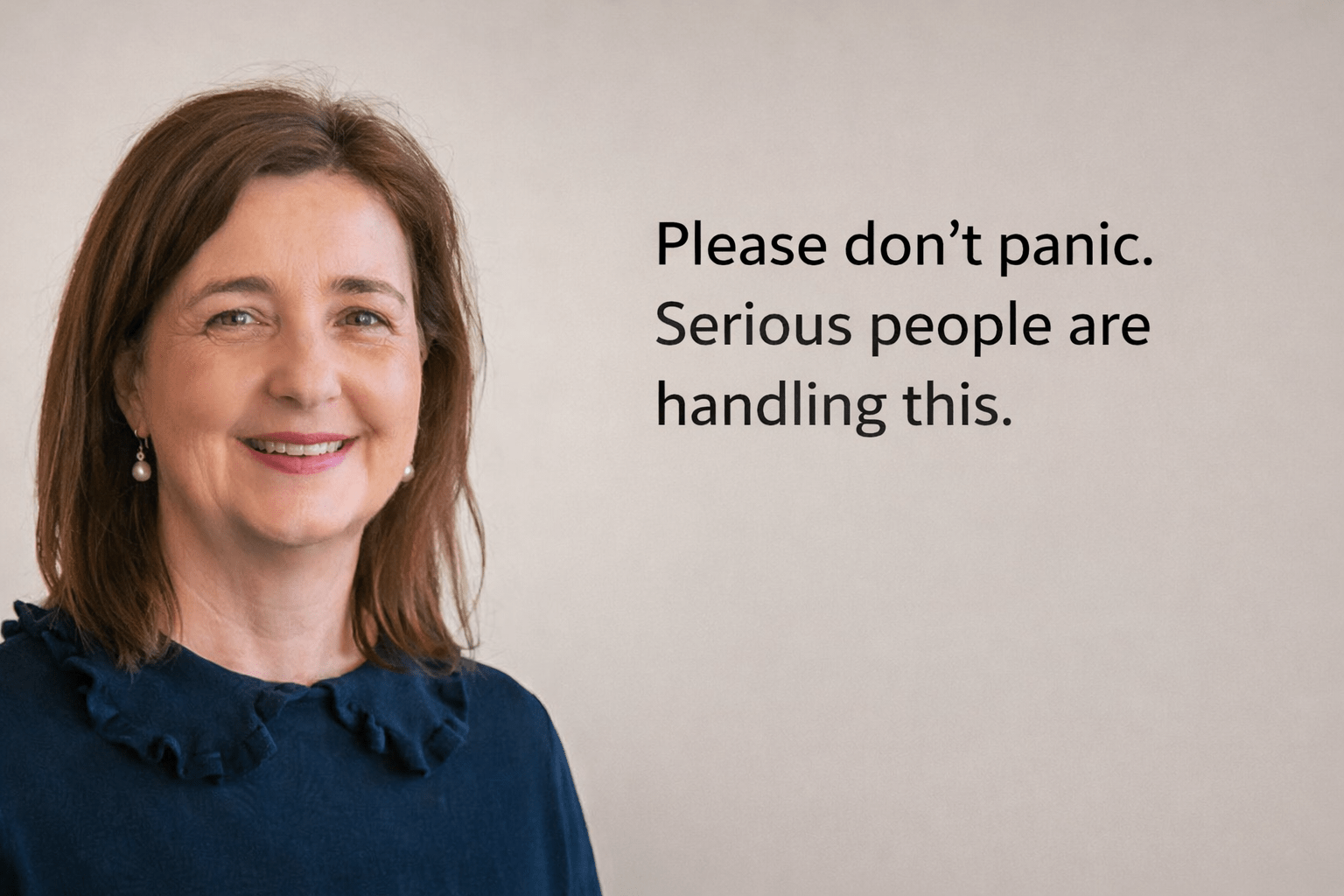
Shropshire Council has written to its staff to reassure them.
This is always a bad sign.
Councils do not issue soothing messages unless something has gone badly wrong. Calm language is deployed only after the fire alarm has been ripped off the wall and quietly hidden behind a potted plant.
The tone is gentle. Responsible. Almost parental.
Everything is under control.
Nothing alarming.
Please remain seated.
There is, we learn, a £195 million funding gap over four years.
This figure is immediately anaesthetised with the phrase “if we do nothing” — a marvellous piece of institutional theatre suggesting that decisive action is already underway, somewhere, by someone, presumably competent.
What is not explained is what has already been done, who authorised it, or why £156 million of previous “savings” has delivered the council to the edge of a financial ravine with such admirable efficiency.
Apparently, this just happened.
£156 MILLION SAVED — AND STILL FALLING
The memo proudly informs staff that £156 million has already been saved.
This is presented as reassurance.
In any other setting, a normal person might ask how removing £156 million from services still leaves a £195 million hole. In local government, this is treated as a mystery of the universe — like dark matter, or where senior officers go when the consequences arrive.
The question “who signed this off?” is not asked.
The question “why was this allowed?” is not asked.
The question “how did this pass scrutiny?” is not asked.
Instead, we are invited to admire the calm.
TRANSFORMATION: SAYING THE WORD MAKES IT REAL
No council memo is complete without the sacred word: “transformation”.
Transformation is the linguistic equivalent of throwing glitter at a structural failure. It sounds exciting, promises everything, commits to nothing, and is extremely useful when responsibility needs to exit the building.
Transformation does not describe an outcome.
It describes an evasion.
NO REDUNDANCIES — JUST LESS EVERYTHING
Staff are reassured there will be no mass compulsory redundancies.
This sounds generous until the next sentence quietly explains that services may be reduced, reshaped or stopped altogether.
Translated from council into English:
the same staff, delivering less.
Residents will pay more.
They will receive less.
Everyone is invited to pretend this is a success.
This is not efficiency.
It is managed decline, delivered with a smile.
CORNOVII: THE SILENCE THAT SCREAMS
The memo says absolutely nothing about Cornovii Developments Ltd.
This is impressive, given that Cornovii represents one of the largest financial risks the council has ever created.
A council-owned company.
Funded by public borrowing.
Backed by public land.
Sold as safe.
The risks were known.
The assurances were repeated.
The scrutiny was polite.
You cannot talk about stability while hiding the largest instability you built yourself. Unless, of course, the objective is not honesty but tranquillity.
THE EXITS THAT EXPLAIN EVERYTHING
The senior officers most closely associated with this model are no longer in post.

They did not remain to manage the consequences.
They did not stay to explain why the risks were acceptable.
They did not face staff with a £195 million problem.
They left.
The exposure stayed.
The debt stayed.
The bill stayed.
This is not coincidence. It is timing.
SCRUTINY, BRIEFLY CONSIDERED — THEN ABANDONED
At no point does the memo explain how elected members were assured this risk was under control.
More troubling still, when concerns have been raised publicly, members of the opposition have been heard to say “nothing to see here”.
This is an unusual definition of opposition, but a very convenient one.
Democracy does not fail dramatically.
It fails politely, when no one wants to be awkward.
SACRIFICE, FOR OTHER PEOPLE
Residents are told the system is unaffordable.
Services are told to shrink.
Staff are told to do “less differently”.
Yet the council’s most expensive long-term commitments are never mentioned.
Not once does the memo ask whether senior officer reward or pension arrangements should reflect the financial reality now being imposed on everyone else.
Sacrifice, it seems, is essential.
Just not universal.
THIS IS NOT LEADERSHIP. IT IS STAGE MANAGEMENT.
This memo is not honesty.
It is not accountability.
It is preparation.
Preparation for higher bills.
Preparation for fewer services.
Preparation for the moment residents ask who built the risk — and discover that the people responsible have already slipped out through a side door, leaving behind a calm note and a very large invoice.
The reckoning will not arrive by email.
It will arrive quietly, on a council tax bill, in a closed service, and in the silence that follows the question:
WHO SIGNED THIS OFF?
 The Alternative Council