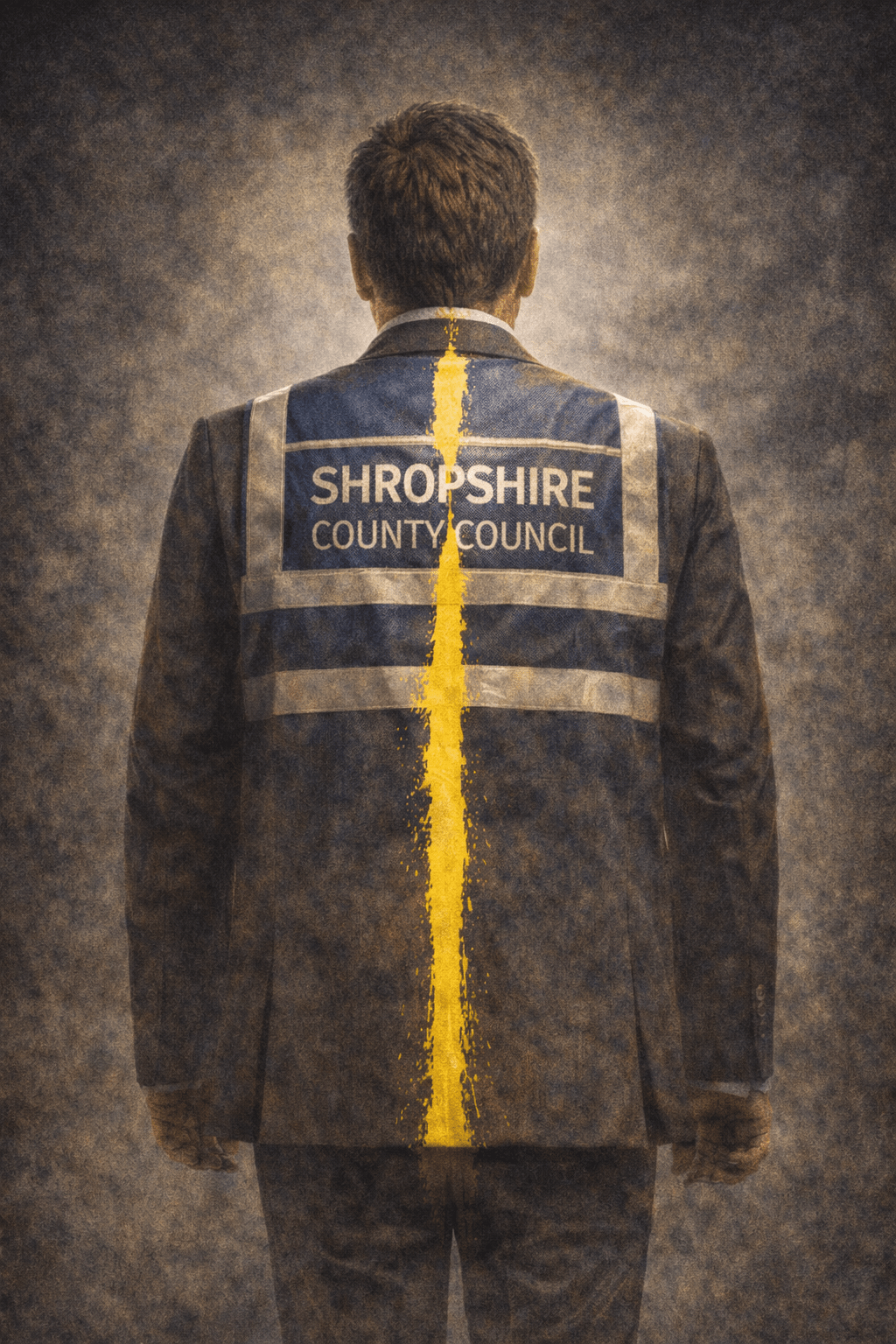
Devolution: How Responsibility Was Abandoned, Bills Were Exported, and Accountability Quietly Abstained
Devolution, in theory, is about local empowerment.
In Shropshire, it has become something else entirely: the systematic off‑loading of cost, risk, and responsibility from a failing unitary authority onto the smallest, least‑resourced tier of local government — and ultimately onto residents.
Let us be absolutely clear about what is happening.
Shropshire Council has run itself into a financial cul‑de‑sac. Faced with a structural deficit it neither planned for nor controlled, it has chosen not to reform itself, but to export the problem downstream. Services once funded and delivered at county level are now being “offered” to town and parish councils — with the not‑so‑subtle warning that if they do not accept them, those services may simply disappear.
This is not partnership.
It is financial coercion with a smile.
It is time to stop pretending this is devolution, and start calling it what it is: failure, repackaged as empowerment, handed to someone smaller — and denied, loudly, by those who created it.
The Mechanics of the Off‑Loading
Shropshire Council identifies a service it can no longer afford — grass cutting, street cleaning, parks maintenance, public conveniences, minor highways functions.
It then:
• Withdraws or de‑prioritises that service
• Invites town or parish councils to “take it on”
• Offers short‑term, declining, or illusory funding
• Retains the council tax already paid for the service
• Walks away from the long‑term liability
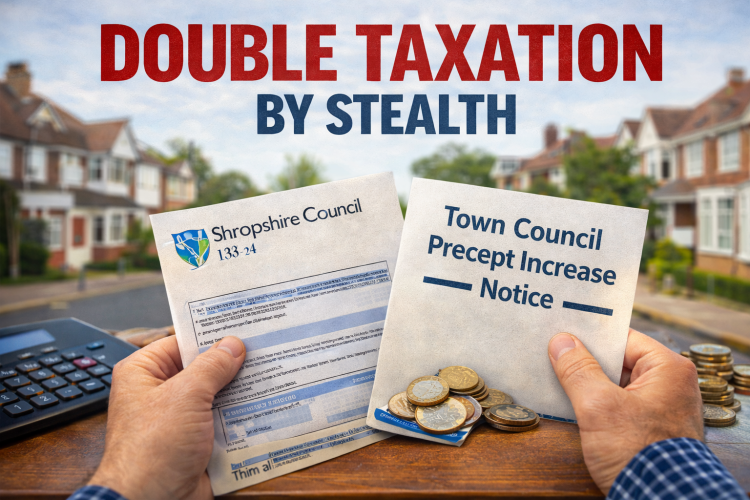
The result is double payment by residents:
Once to Shropshire Council, which no longer delivers the service.
Again through sharply increased town or parish precepts to keep it alive.
This is not devolution.
It is double taxation by administrative sleight of hand.
The Consequences They Don’t Put in the Report
Town and parish councils are not mini‑unitary authorities. They do not have:
• Large officer teams
• Procurement capacity
• Reserves to absorb shocks
• Flexibility to carry long‑term risk

So what happens?
• Precepts rise sharply
• Clerks and staff are stretched
• Volunteers replace paid labour
• Contracts are rushed
• Inequality emerges between communities
This is how postcode lotteries are engineered.
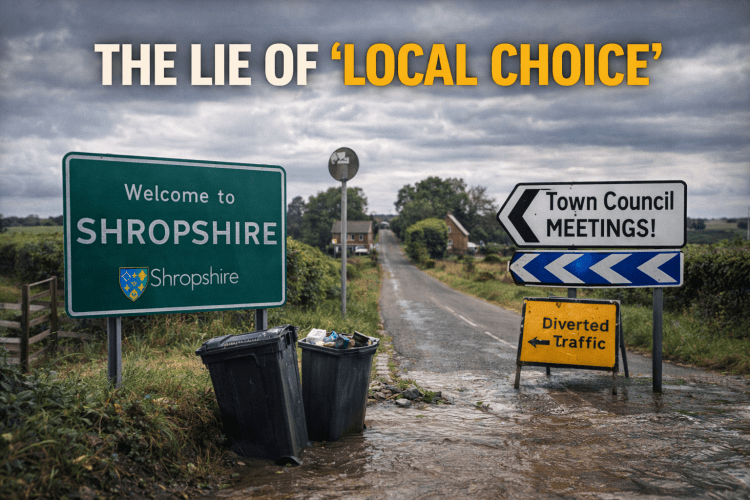
The Lie of “Local Choice”
When the alternative to taking on a service is watching it wither or vanish, that is not choice.
It is coercion.
Shropshire Council keeps the tax base.
Parishes take the blame.
A Council That Governs by Disappearing
Rather than reform itself, Shropshire Council devolves pain and steps back, hoping nobody notices who signed the invoice.
This is not leadership.
It is governance by retreat.
Brutal Closing: The Cowards of the County
Devolution did not happen in a vacuum.
It happened because too many councillors chose not to stop it.
Some voted for it.
Some defended it.
And too many abstained.
Abstention is not neutrality.
It is the mechanism by which responsibility disappears without resistance.
Dual‑hatted councillors — sitting on Shropshire Council while also serving on town or parish councils — were uniquely placed to challenge this off‑loading.
Many did not.
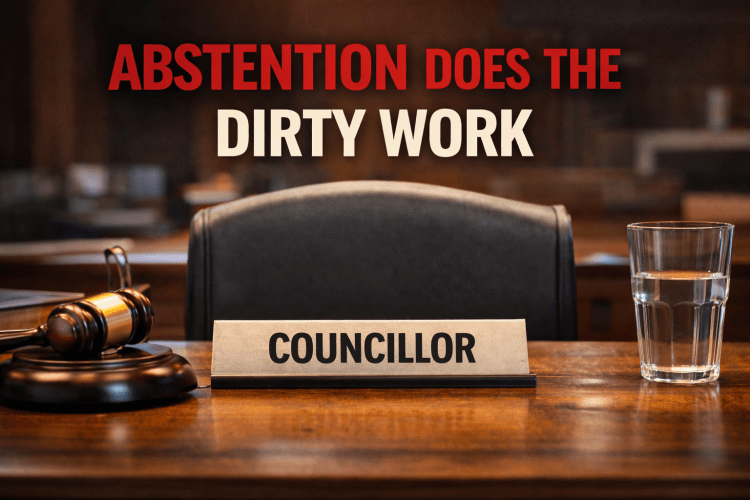
Instead of recusing themselves properly, or voting with conviction, they hovered safely in the margins — present, participating, but unwilling to be counted.
That is not governance.
That is cowardice with a procedure attached.
When councillors abstain on decisions that export cost, fracture services, and raise taxes by stealth, they are not standing above the outcome.
They are standing behind it, hoping not to be named.
History does not remember abstentions.
It remembers consequences.
And the consequences of this devolution will be paid — not by those who designed it — but by the communities left holding the bill.
One Detail They Prefer You Didn’t Notice

While services were being off‑loaded, responsibilities devolved, and communities warned to expect higher precepts, Shropshire Council quietly found time for something else entirely.
In May last year, councillors approved increases to allowances and expenses.
This detail matters, because it exposes the moral vacuum at the heart of the devolution programme.
At the very moment councillors were asking town and parish councils to take on unfunded services, to stretch clerks, rely on volunteers, and raise local taxes, they simultaneously chose to protect — and enhance — their own financial position.
This was not imposed by government. It was not unavoidable. It was a conscious decision.
A council that genuinely believed money had run out would not have increased what it paid itself. A council that genuinely believed residents must share the pain would not have ring‑fenced its own comfort.
Instead, austerity was devolved downward — while allowances flowed upward.
That contrast tells you everything you need to know about priorities — and nothing that was intended for public attention.
It is time to stop pretending this is devolution, and start calling it what it is: failure, repackaged as empowerment and pushed downhill — because liquidating Cornovii Ltd would solve the problem, and those who caused it have already taken their leave.
 The Alternative Council