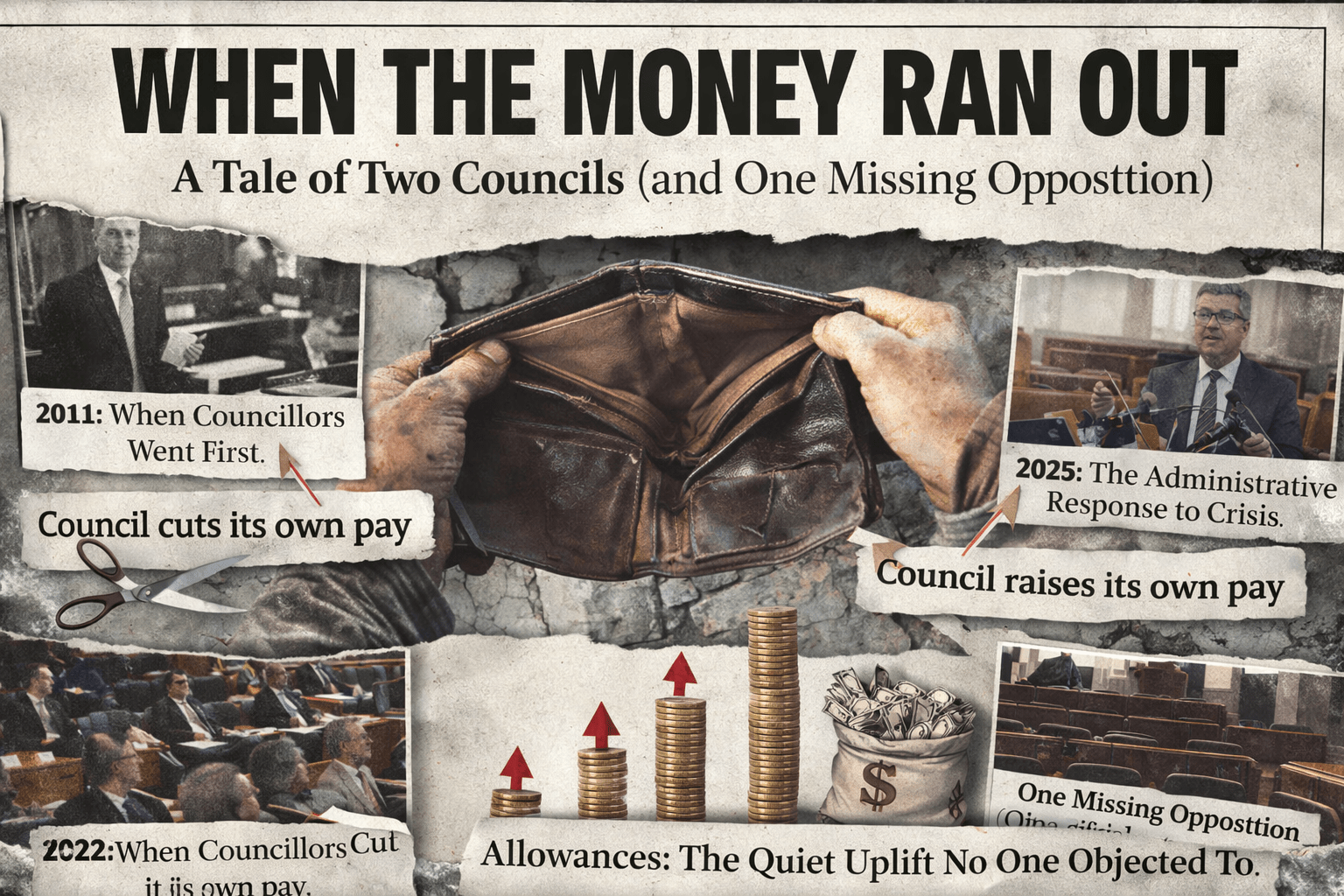
There are only two honest ways to respond to a financial crisis.
You either take less yourself — or you become very clever indeed.
Shropshire Council has tried both. Just not at the same time.
2011: When Councillors Went First
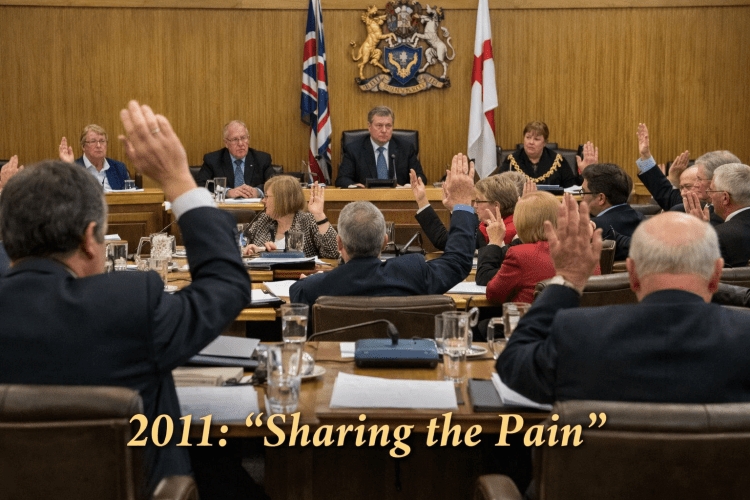
At a full meeting of Shropshire Council in January 2011, during the early austerity period, the authority found itself under serious financial pressure. The response of the day, led by Conservative Council Leader Keith Barrow, was unfashionably direct.
Council decision (January 2011 – agenda item: Members’ Allowances):
Councillors voted to cut their own basic allowance by five per cent. Travel and mileage expenses were reduced, and senior officers accepted similar cuts.
The reasoning was brutally simple: council staff were facing a pay freeze and changes to their terms and conditions, so councillors would “share the pain”*
No reviews. No multipliers. No reassurance that the sums still looked polite.
They simply took less money.
Some of the savings were even redirected into a charitable trust for young people — an act of fiscal recklessness so extreme it would probably now require a business case explaining why it was impossible.
This was not symbolism. It was leadership. Untidy, uncomfortable, and unmistakable.
2025: The Administrative Response to Crisis
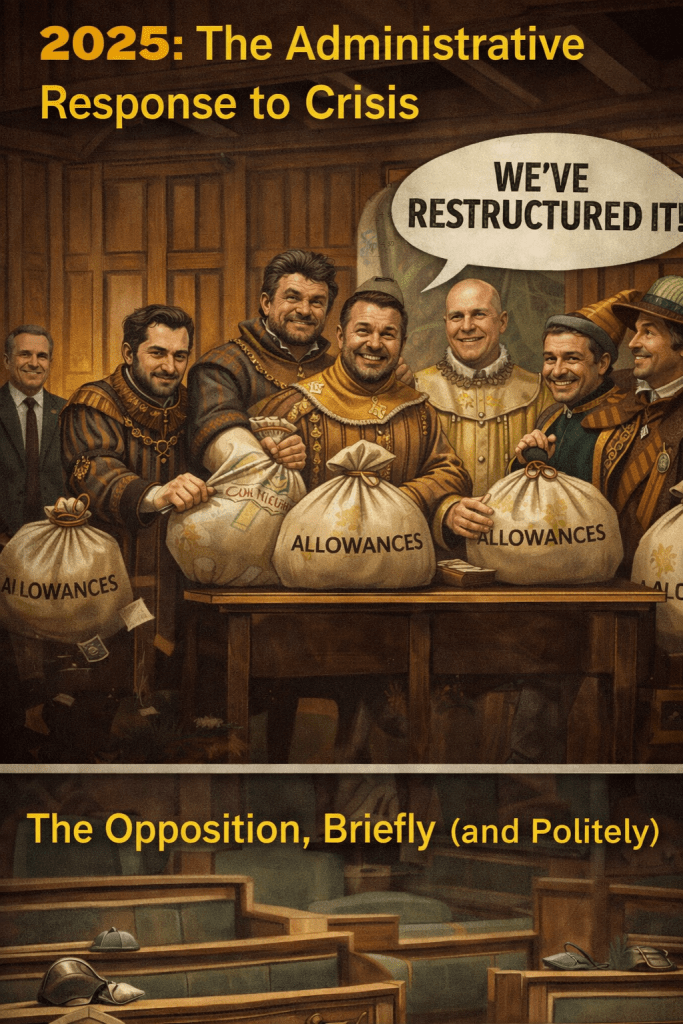
Fast‑forward to 2025. The Liberal Democrat administration has been in office since May 2025. During that period, Shropshire Council has declared a financial emergency, forecast escalating overspends approaching £40–50 million, and assembled a familiar architecture of improvement plans and assurance frameworks.
And yet, at a full Council meeting on 17 July 2025, councillors also approved changes to the Members’ Allowances Scheme, permitting payment for up to ten Deputy Portfolio Holders. This was presented not as an increase, but as a restructuring — a phrase carefully chosen to reassure that there was “no net increase to the budget”.
Nobody took less. They simply took it more imaginatively.
Allowances: The Quiet Uplift No One Objected To
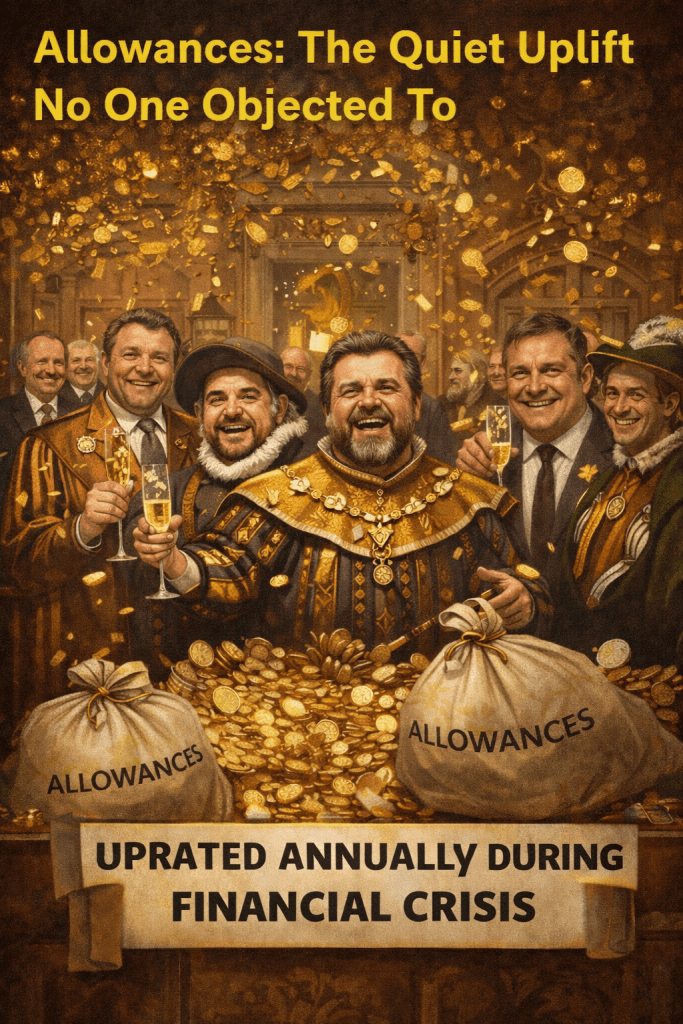
Between April 2021 and April 2024, Shropshire Council quietly implemented a sustained uplift to Members’ Allowances.
The basic councillor allowance rose from £12,000 to £14,378.98 — an increase of almost 20 per cent. The Leader of the Council’s allowance rose from £27,000 to £32,352.71. Portfolio Holders, Scrutiny Chairs, Planning Chairs and other senior roles all rose in line with the same indexed framework.
These increases were not presented as pay rises. They were described as “uprating”, applied through multipliers embedded within the Members’ Allowances Scheme and reported as technical adjustments rather than political choices.
The effect, however, was unmistakable: while services tightened, reserves weakened and financial risk accumulated, councillor remuneration continued to rise — predictably, annually, and without interruption.
What is most striking is not the mechanism, but the absence of dissent.
No recorded objection. No call for restraint. No argument that allowances should be frozen until the Council’s finances stabilised.
In an authority now warning that the money has run out, this is one area where continuity was preserved with admirable discipline.
The Opposition, Briefly (and Politely)
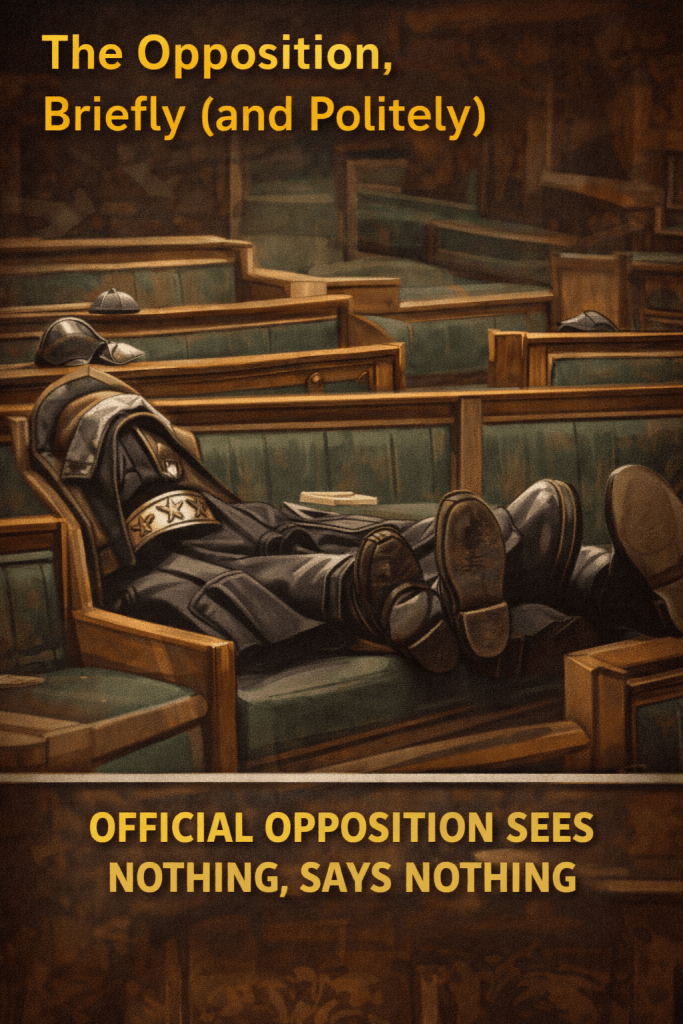
A word, too, for the official opposition. On the question of allowances — specifically agenda item 30 at Council on 17 July 2025 — no objection was raised. The opposition voted with the administration.
In 2011, councillors cut their own pay. In 2025, allowances were re‑engineered. And the opposition assisted with the paperwork.
My opinion: It takes rare political flexibility to campaign as a rebellion and govern as a footnote.
2025: When Cleverness Replaced Sacrifice
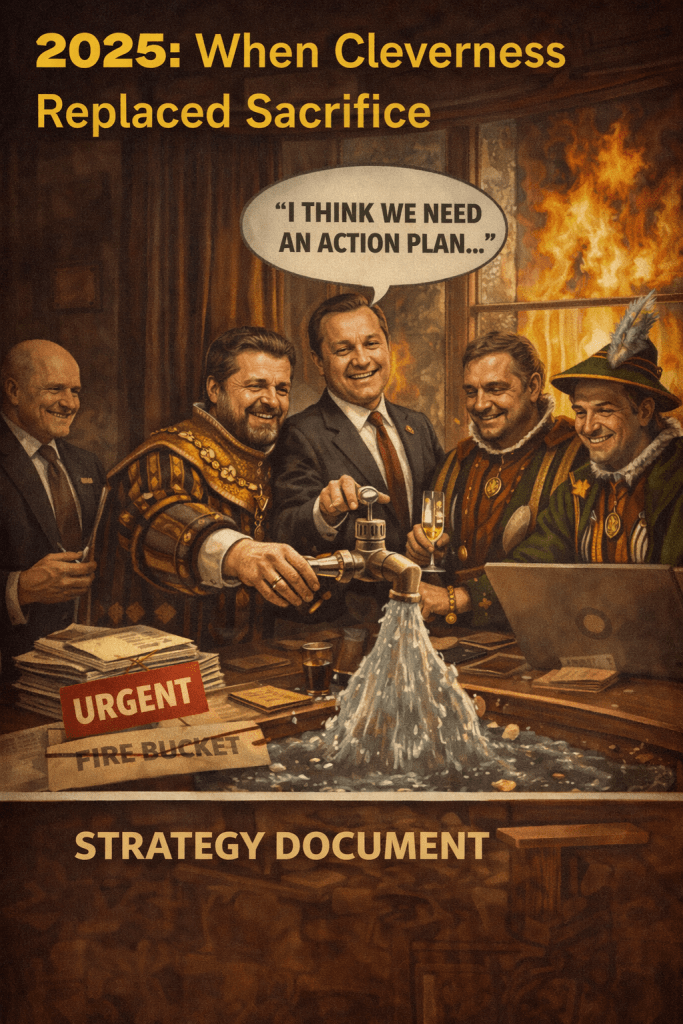
Let us end with an observation rather than an accusation.
In 2011, councillors responded to crisis by taking less. In 2025, councillors respond by rearranging how they take it.
This is progress, of course — in the same way that replacing a fire bucket with a strategy document is progress.
My opinion: The difference between then and now is not intelligence or competence. It is nerve. One administration chose to look poorer in order to be honest. The other chooses to look clever in order to remain comfortable.
When the house was on fire, yesterday’s councillors fetched water. Today’s councillors convene a meeting to discuss the hydrant — and reassure us, earnestly, that no additional water has been budgeted.
History will not be angry about this. It will be bored.
 The Alternative Council