
Homes England, Cornovii and the Grand Tradition of Official Incompetence
This article makes no allegation of fraud or corruption. That would require intent. What follows is about something far more pervasive and far more embarrassing: institutional stupidity, protected by process and polished by press releases.
If failure carried a health warning, Homes England and Shropshire Council would be sold with a leaflet. Instead, they are sold as success stories, despite all available evidence suggesting the opposite.
Homes England: The National Masterclass in Not Delivering

Homes England was created to build homes. Not to talk about homes. Not to commission consultants to write essays about homes. To build them. Yes, it is yet another failed quango, generously funded and lightly supervised.
And yet, year after year, it manages the same trick: miss targets, lower targets, miss them again, then return billions of pounds of unspent money to the Treasury while congratulating itself on “strong performance”.
This is not efficiency. It is a government-sponsored pantomime. Public money goes in; reports come out; homes do not.
Consultants, meanwhile, thrive. Eye-watering day rates are paid to explain why nothing has happened, why delays are inevitable, and why next year will definitely be different. It never is.
Cornovii Ltd: When the Council Decides It Knows Better
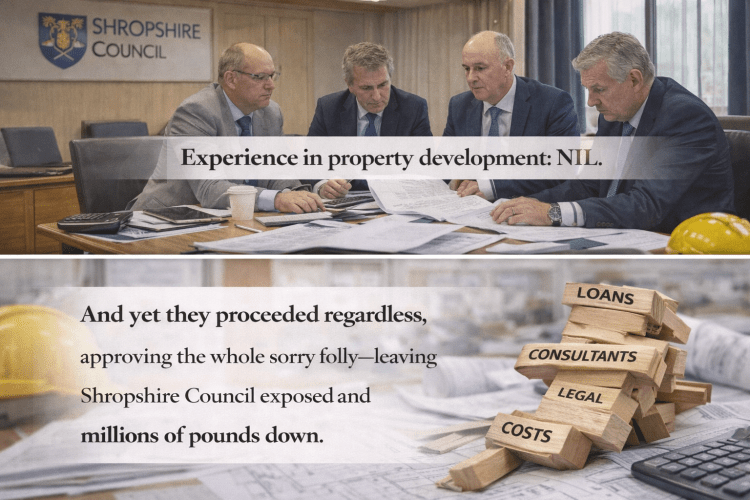
Watching this from Shropshire, the Council appears to have had a Damascene revelation: if national government can fail expensively at development, why shouldn’t local government have a go?
Thus Cornovii was born. A council-owned property company, funded by council loans, built on council land, overseen by council officers, scrutinised by council committees, and defended by councillors who seemed genuinely surprised when anyone asked how it was going.
Professional developers fail all the time, even with decades of experience and market discipline. Shropshire Council entered the arena armed with optimism, consultants, and a working assumption that accountability was optional.
The result? Escalating loans running into the tens of millions. Corporate structures so convoluted they would impress a tax lawyer. Consultancy and legal costs breeding quietly in the background. And reporting so opaque that even basic questions became “commercially sensitive”.
Commercially sensitive to whom, exactly? The taxpayer?
Five FOIs, Zero Answers
To clear up the confusion, five Freedom of Information requests were submitted. Nothing exotic. Just the sort of questions any vaguely competent organisation would expect to answer without breaking sweat: finances, governance, decision-making, relationships.
Five deadlines came and went. No proper answers arrived. No lawful refusals were issued. No public-interest tests were attempted. Just silence, obfuscation, and procedural shrugging.
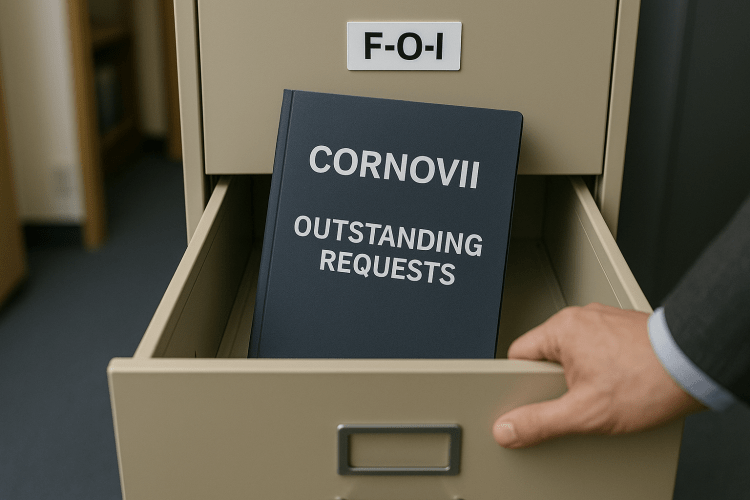
Five requests. Five failures.
At that point, silence stops being accidental and starts looking like policy.
The Curious Case of the Vanishing Decision-Makers
Cornovii was no rogue officer project, although officers were deeply involved. It was politically sponsored, politically endorsed, and politically defended — repeatedly — by named individuals who now prefer silence to explanation.
The political landscape is not obscure. Cabinet members approved the direction of travel. Councillors sat on supervisory boards. Planning decisions were taken by people who were simultaneously promoting the company whose applications they were judging.

Among those at the centre of this arrangement were Cllr Dean Carroll, a senior figure during Cornovii’s expansion phase, and Cllr Steve Charmley, Cllr Robert Macy, Cllr Robert Gittins, and Cllr James Owen — all of whom were part of the political environment that approved, enabled, or failed to challenge the experiment.
Not one of them brought relevant commercial development experience to the table. Not one appears to have insisted on hard limits, clear exit strategies, or transparent reporting. Oversight was present in name, absent in practice.
As questions mounted, several of these figures exited the stage. Their silence since has been deafening. Oversight, it seems, expires the moment personal accountability comes into view.
Continuity Without Competence
While councillors came and went, Cornovii enjoyed one constant: Harpreet Rayet. Continuity is often praised as stability. Here it deserves a more accurate description.
Mr Rayet has spent his entire working life in local government. His experience in commercial property development: nil. Yet he simultaneously occupied pivotal roles across the council’s housing ecosystem — senior officer, managing director of Cornovii, and chief executive of STAR Housing.
Developer. Landlord. Overseer. Sometimes at the same time.
This is not arm’s-length governance. It is circular control dressed up as structure. Continuity without scrutiny is not stability; it is inertia with a business card.
Experience: An Inconvenient Absence
Here lies the heart of the farce. A collection of career local government administrators and councillors—none with any meaningful experience in property development—decided they were perfectly qualified to establish, finance, and run a commercial development company.
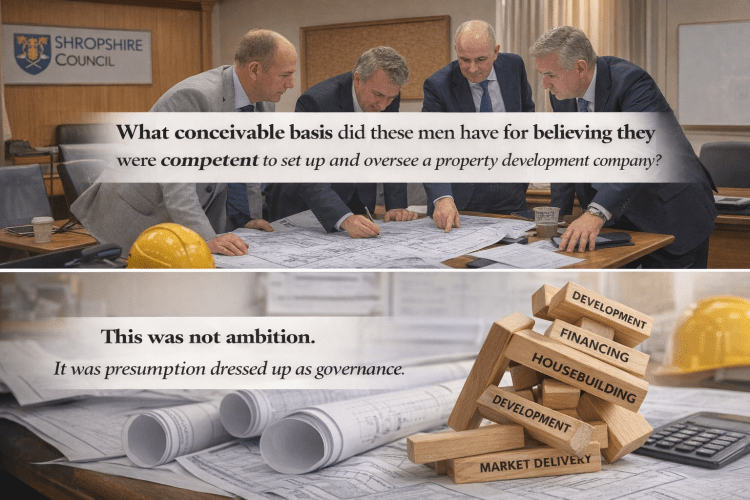
Experience in property development: nil.
This minor inconvenience did not prevent them from approving loans approaching £70 million, secured against public assets, underwritten by the same council that owned the company, controlled planning, and congratulated itself on robust governance.
Confidence, as ever, triumphed over competence.
The Sum Nobody Wants to Add Up
There is a calculation Shropshire Council avoids at all costs. Remove Cornovii from the equation and the accumulated expense—loans, consultants, legal gymnastics, officer time, corporate theatre—would have gone a very long way towards plugging today’s financial hole.
Instead, residents are told the cupboard is bare, austerity unavoidable, and sacrifices necessary. The paperwork explaining how this happened, however, remains mysteriously unavailable.
Devolution: Passing the Bill, Not the Power
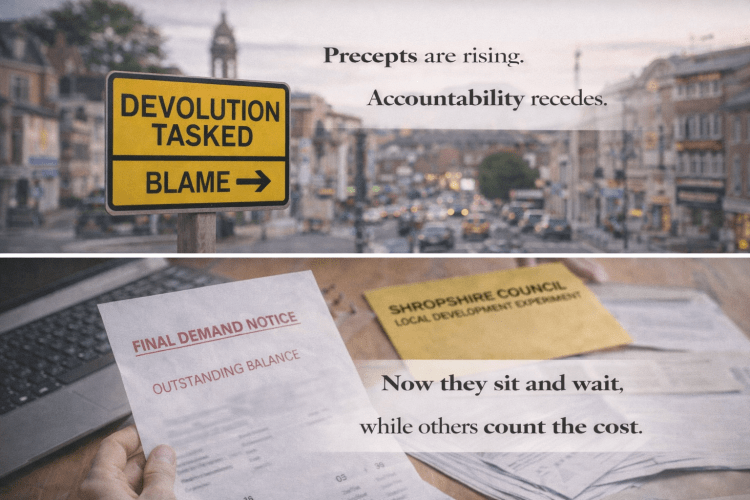
The latest wheeze is devolution. Sold as empowerment, it functions rather better as cost dumping. Grass cutting, litter picking, street cleaning—off-loaded to town and parish councils without the funding to match.
Precepts rise. Accountability evaporates.
This is not the devolution of power. It is the devolution of blame, neatly wrapped and posted downstream.
Cornovii remains. The answers do not arrive. The FOIs remain unanswered. But the invoice is already being delivered—to parish councils, and ultimately, to residents.
Conclusion: Failure, Normalised
This is not a scandal. It is something worse: failure treated as normal, protected by process, and excused by jargon. Institutions that no longer feel obliged to explain themselves. Leaders who depart before scrutiny lands. A governing culture that mistakes silence for wisdom.

The council was asked. Repeatedly. It chose not to answer.
And now, with grim consistency, it asks the taxpayer to pay for the privilege.
Register and sign the Petition Against Develution (PAD) https://c.org/9c8KKXrmdb
 The Alternative Council