
This Is What Cowardice Looks Like
There is a new planning doctrine stalking Shropshire. It is not written down. It has not been voted on. It comes with no consultation, no mandate, and no courage.
It is called Pre‑Emptive Surrender.
Its guiding principle is simple: if a developer might win an appeal, fold early, avoid the fight, and call it “professional judgement”.
This is not planning. It is capitulation with a clipboard.
The Policy Nobody Will Defend
I am informed — by more than one source — that permission at 23 Cross Street, Oswestry has been granted not because it satisfies policy, strengthens the street, or serves the public interest, but because Shropshire Council fears losing an appeal.
If that is correct, then something profoundly rotten has settled into the system.
Because once fear of appeal becomes decisive, policy becomes optional, public objections become decorative, and committees become theatre.
Residents turn up. Papers are written. Speeches are made.
And somewhere, quietly, the decision has already been taken.
From Planning Authority to Risk‑Management Unit
Let us pause on what this logic really says.
It says that:
- adopted policy can be overridden by speculation
- democratic process can be trumped by a barrister’s opinion
- community harm is acceptable if it avoids institutional embarrassment
That is not the rule of law. It is the rule of nerves.
Once this mindset takes hold, the planning authority stops deciding and starts anticipating defeat. Developers learn the trick. Threaten appeal. Watch the spine soften.
The result is not planning certainty. It is open season.
Cross Street Today. Everywhere Tomorrow
23 Cross Street is not a one‑off. It is a signal.
If “we might lose on appeal” is now sufficient to unlock consent, then every marginal proposal is suddenly viable, every objection provisional, every policy negotiable.
Why bother defending a plan at all if the first sign of resistance produces a retreat?
This is how a planning system eats itself.
Smithfield: The Permission That Dare Not Speak Its Name
Meanwhile, the air around 1 Salop Road — the former Smithfield Hotel — is thick with expectation.
The expectation is not being fuelled by residents or objectors. It is being fuelled by silence. By the absence of denial. By the familiar choreography:
- concerns raised
- questions avoided
- confidence expressed
- permission delivered
All wrapped in the same anaesthetic phrase: “We were advised.”
Advised, it seems, is now the opposite of accountable.
Leadership, Absent Without Leave
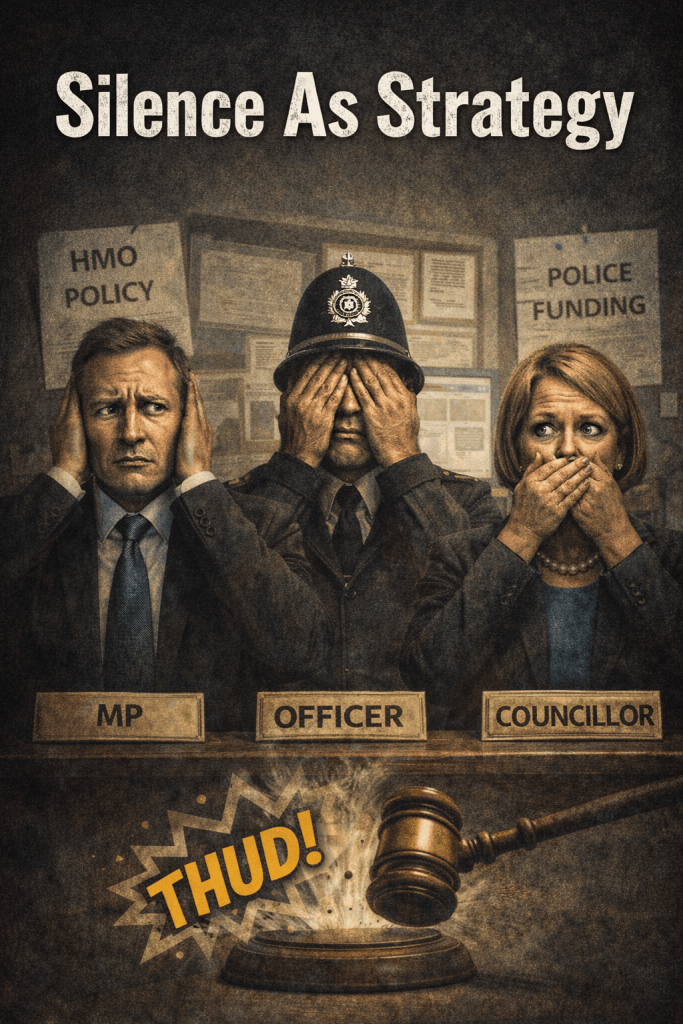
At moments like this, one might expect a word from the area’s Member of Parliament.
HMOs multiplying. Communities ignored. Planning decisions apparently driven by fear rather than judgement.

Yet Helen Morgan MP has offered no public comment on Cross Street, Smithfield, or the wider pattern consuming Oswestry.
Perhaps the briefings are still being digested. Perhaps the politics are awkward. Perhaps silence is the safest option when nobody wants to upset the planning applecart.
But silence, in public office, is not neutrality.
It is a decision.
Enter the Cowards of the County

And so, we arrive at the central cast: the Cowards of the County.
They are not villains. That would require intent.
Councillor Julian Dean: Chairman of Planning Committee North, One must admire his consistency, even if it is the consistency of a jellyfish left too long on a warm beach.
They are something far more damaging: people in authority who know better and choose safety instead.
They speak fluently about community. They quote policy until it becomes inconvenient. They praise engagement right up to the moment it needs defending.

Councillor Mark Owen first voted against the application, then executed a tidy volte-face at the second meeting, voting to pass responsibility to Councillor Dean. Principles, it seems, are safest when delegated.
And when challenged, they retreat behind the modern shield:
“We were advised we might lose on appeal.”
Advice has become a substitute for backbone.
Planning by Panic
Let us be honest with the public.
If planning decisions are now to be determined primarily by appeal risk, then councils should say so openly.
They should print it on the forms:
- Objections noted, outcome unchanged
- Policies applied unless challenged
- Democracy subject to legal advice
Because what is happening here is not balance. It is panic management.

A system so frightened of inspectors that it no longer believes in itself.
Final Question (Unavoidable)
If this council genuinely believes its planning policies are sound, why does it keep running from the first hint of challenge?
And if it does not believe in its own policies, why should residents?
Because once fear replaces judgement, planning is finished.
What remains is a slow, quiet haemorrhage of trust — and a town left to live with the consequences.
And with hindsight, the image of Messrs Sidhu and Salt chuckling together in the car park — fresh from “losing” the first planning meeting — feels less like optimism and more like inside knowledge.
If national politics insults you openly, this version operates by stealth.
No warning. No honesty. Just the expectation that residents will keep their eyes shut while planning and democracy is quietly surrendered.
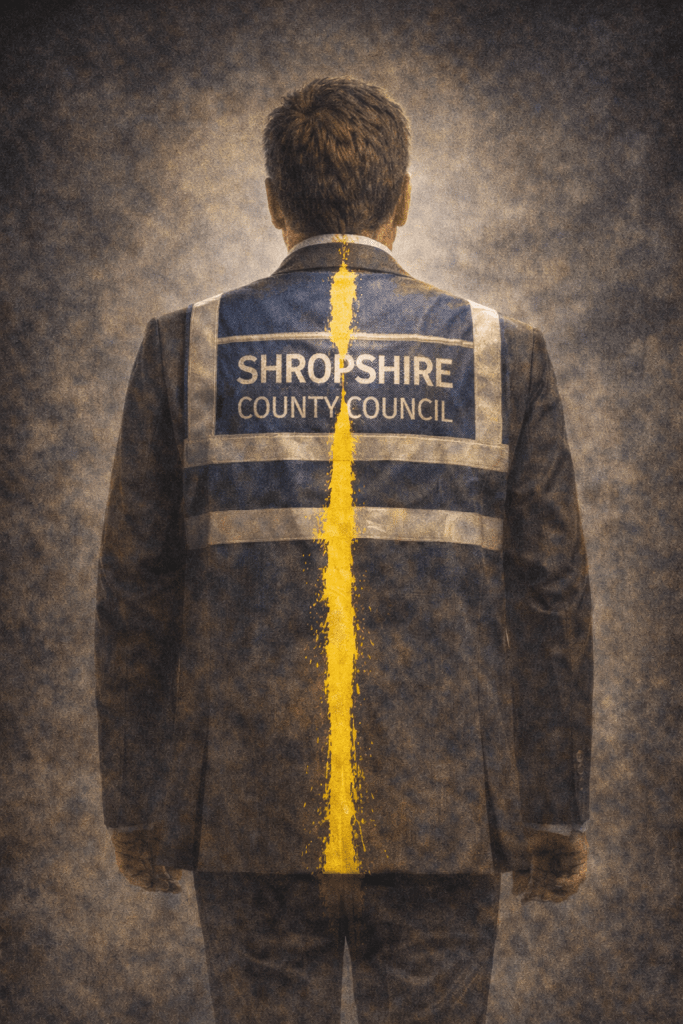
THE COWARDS OF THE COUNTY
P.S.
There has, at last, been movement on Cornovii. I am assured that all five overdue FOIs will arrive by 23 December 2025.
That makes the first blog of the New Year fairly predictable.
Register now if you’d like it before the excuses begin.
 The Alternative Council