
Localism, Lies – and the Great Parish Bill

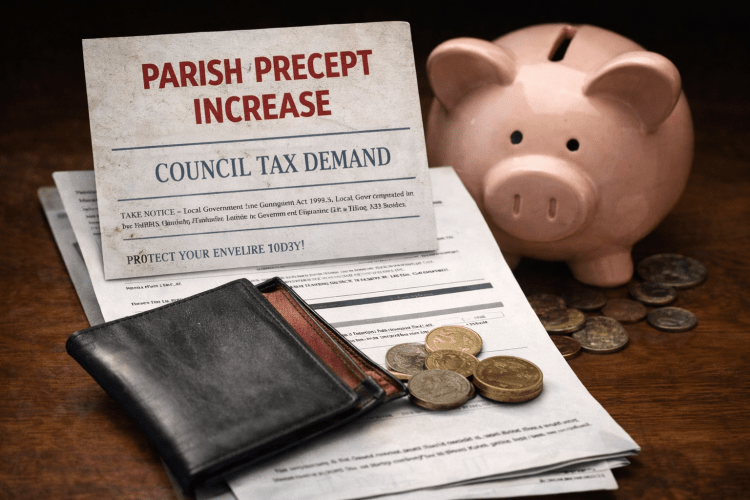
Shropshire Council has perfected a simple, cowardly trick: when something costs money, it stops paying for it and pushes the bill onto someone smaller. Then it smiles, calls it *localism*, and waits for parish councils to take the anger. This is not devolution, reform, or community empowerment. It is cost dumping — deliberate, calculated, and dressed up to look virtuous while residents quietly pay more for less.
Shropshire Council’s finances are in a state that polite people describe as ‘challenging’ and honest people describe as ‘self-inflicted’. The response has not been competence, restraint, or accountability. Instead, we have discovered a bold new doctrine:
‘If we stop paying for it, we can pretend we stopped needing it.’

So services are ‘reviewed’.
Responsibilities are ‘reconsidered’.
Assets are ‘reimagined’.
And parish councils are ‘empowered’ — which in plain English means *presented with a bill*.
Parish and town councils are often described as *volunteer-led*. This description becomes less convincing the moment Shropshire Council starts unloading operational services onto them.
Once the dumping begins, parish councils inherit:

– Ongoing maintenance
– Contractor management
– Public anger
– Rising costs
– Zero strategic leverage
And yes, allowances
In Oswestry, for example:
– Councillors receive roughly **£800 per year**
– The Mayor receives around **£5,000 per year**
Entirely lawful. Properly declared. Not the issue.
The issue is this: When you dump services onto smaller councils, you force them to raise precepts — and then quietly step back while they absorb the political fallout.
Residents don’t shout at Shropshire Council.
They shout at parish councillors.
And Parish/Town councillors will no longer be able to say : “nothing to do with us; that’s County”, because suddenly it is them.
Mission accomplished.
This will not stop at grass cutting.
Once the principle is accepted, every non-statutory service becomes a candidate for dumping.
If Shropshire Council were honest, reports would say:
‘We cannot afford to maintain this anymore, so we are passing the cost elsewhere.’
Instead, residents are fed phrases such as:
– “Local solutions”
– “Community partnership”
– “Opportunities for local management”
– “Enhanced local accountability”
What these actually mean is:
‘We’re broke — but we’d rather you argued with someone smaller.’
This language is not accidental.
It is not sloppy.
It is **protective camouflage**.
If this policy is such a triumph of democracy, a question naturally arises:
Why does it happen so quietly? Why does it appear:
– Halfway down agendas
– Buried in appendices
– Passed without parish-by-parish costings
– Nodded through without public challenge

Where are the councillors demanding:
– Full financial comparisons
– Long-term sustainability assessments
– Honest warnings to residents?
Absent.
And silence, in this context, is not neutrality.
It is **consent**.
No conspiracy theories are required.
Just a familiar local government instinct: ‘Move the problem sideways, document it carefully, and let someone else explain the consequences.’
When parish councils struggle:
– “They’re independent bodies.”
When precepts rise:
– “Local decision-making.”
When residents complain:
– “It’s no longer our responsibility.”

Cost dumped.
Blame outsourced.
Hands washed.
Freedom of Information requests are already in motion.
They will ask tedious but dangerous questions:
– What Shropshire Council used to pay
– What parish councils now pay
– Who approved the shift
– Why no cumulative impact was published
The answers won’t shock anyone paying attention.
They will simply remove the remaining cover.
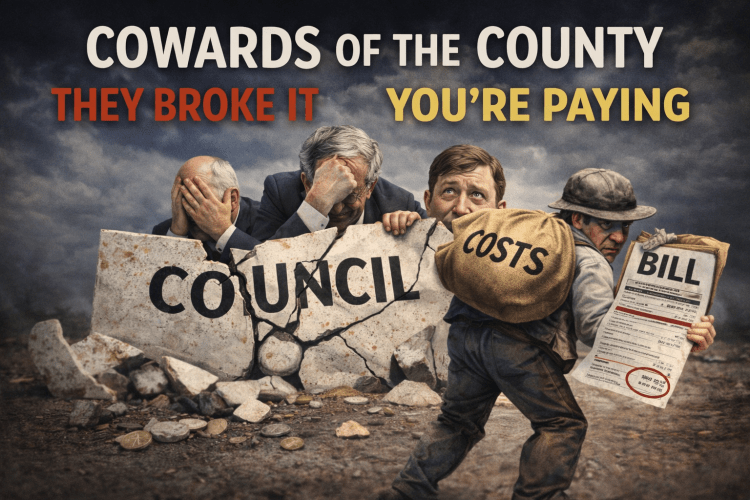
Shropshire Council has not made tough decisions — it has dodged them.
It has not empowered communities — it has abandoned them with invoices.
And it has not solved its financial crisis — it has simply shoved the cost downhill and hoped parish councils would take the blame in silence.
This isn’t leadership. It’s evasion. And every councillor and officer who nodded it through, buried it in paperwork, or stayed conveniently quiet owns it. And they really are:
THE COWARDS OF THE COUNTY
Postscript
The submission of Application 25/04670/SCR, requesting an EIA Screening Opinion for some 350 dwellings on agricultural land south of Mount Road, Oswestry, invites one unavoidable question.
If the environmental impact was never in doubt, why was it considered necessary — by both the developer and Shropshire Council — to seek formal screening in the first place?
 The Alternative Council