
There comes a moment in every great British farce when you realise the people in charge are no longer even pretending to steer the ship — they’re simply rearranging the deckchairs and congratulating each other on their boldness. That moment arrived the second Westminster announced its latest stroke of governance genius: abolish the one elected official we can actually identify. Not fix them. Not improve them. Not depoliticise them. No — just tip the whole structure into the recycling bin and hand policing oversight to a committee who can’t even agree on how to fix a streetlight, let alone a police force.
HOW WESTMINSTER BROKE A MODEL, BLAMED THE MODEL, AND IS NOW REPLACING IT WITH SOMETHING WORSE

For policing governance, that moment was when someone in Whitehall, after years of underfunding and political meddling, stared at the PCC model and triumphantly declared:
“Let’s get rid of it. That’ll show it who’s boss.”
A masterstroke, apparently.
Every great British reform disaster has a single, defining moment — the instant you know the whole contraption is about to shed a wheel and skid into the nearest hedge.
Because nothing says “serious reform” quite like taking a struggling system, refusing to fix the bits politicians broke, and then dumping the whole thing in a skip — ideally while handing the keys to a committee of council leaders already navigating budget sinkholes, pothole mutinies, and FOI replies that vanish like steam.
This, apparently, is what progress looks like.
If in doubt, smash it and pretend it’s modernisation.
When the tap leaks, don’t tighten it or change the washer. Rip out the plumbing.
Welcome to Britain’s latest reinvention of the wheel.
THE PCC MODEL: IMPERFECT, UNDERUSED — YET STRANGELY ESSENTIAL
But let’s not romanticise PCCs.
Turnout was anaemic.
Public awareness barely registered.
Some commissioners behaved like minor celebrities with a badge.
But beneath the publicity fluff sat one priceless, critically important truth:
There was exactly one person you could blame.
One person set priorities.
One person signed the cheques.
One person could be voted out.
One person held the line with the Chief Constable.
That level of clarity is almost indecent in British public life — and so, naturally, it had to go.
THE NEW MODEL: ACCOUNTABILITY BY COMMITTEE (OR NO ACCOUNTABILITY AT ALL)
The great abolition plan replaces a single accountable figure with a board of council leaders.
Yes, the same people struggling to keep their own authorities solvent.
Yes, the same people whose inboxes are on permanent life-support.
Yes, the same people who can’t get a pothole filled without a six-week consultation and an archaeological survey.
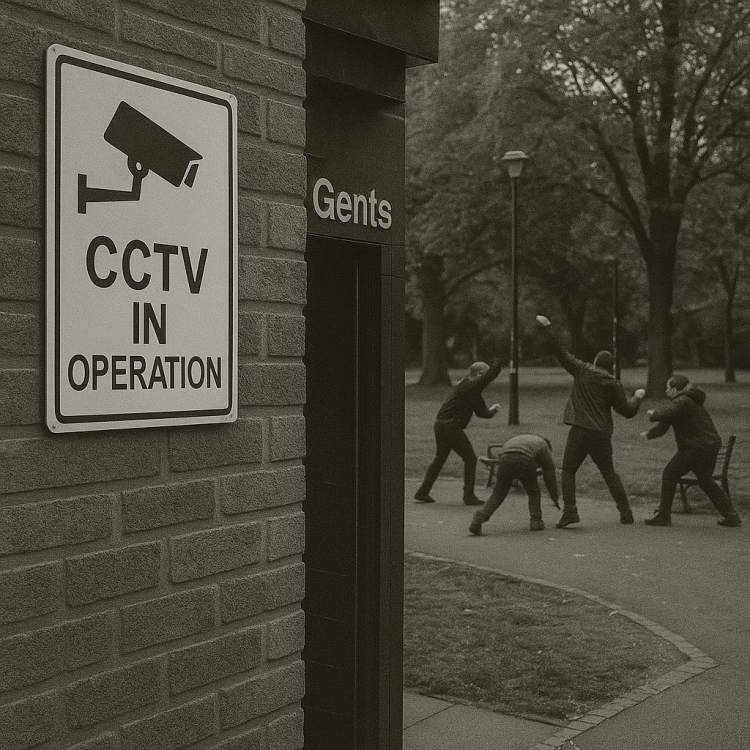
And this collection of dignitaries, incompetents and ne’er-do-wells will now collectively steer the strategy, budget, scrutiny, and direction of West Mercia Police.
Picture it:
Shropshire’s Leader, Telford’s Leader, Herefordshire’s Leader, Worcestershire’s Leader — all gathered around one table, valiantly trying to agree who should fund rural policing this month without triggering a diplomatic incident.

Who’s in charge?
Everyone.
Who’s accountable?
No one.
Who do you vote out when policing fails?
Take your pick. It’s political Whac-A-Mole.
A bold experiment — in how far we can dilute responsibility before it evaporates entirely.
If you ever doubt how well a multi-council committee handles oversight, just ask anyone still waiting for an FOI reply from Shropshire Council.
ACCOUNTABILITY? NOW YOU SEE IT, NOW YOU DON’T
Right now, for all its imperfections, the PCC model has the decency to put one name on the ballot and one face on the door. When neighbourhood policing collapses, there is no mistaking where the buck should stop.

Under the new model?
Accountability becomes a spectator sport:
Everyone gestures.
And therefore no one is responsible.
THE REAL TWIST: THE PCC DOESN’T NEED ABOLISHING — IT NEEDS DE-POLITICISING
The PCC model didn’t fail because the structure was flawed.
It failed because political parties refused to keep their hands off it.
They treated a public safety role like a soft party outpost.
They ran candidates based on rosettes, not competence.
They used PCCs as retirement cushioning or pre-Parliament warm-ups.
They sabotaged their own experiment — and then blamed the experiment.
And now, instead of fixing the sabotage, they’re replacing the whole system with something guaranteed to be worse.
THE REFORM BRITAIN SHOULD HAVE
1. BAN PARTY LABELS ON THE BALLOT PAPER
Remove the rosette. Let the public choose the person, not the colour.
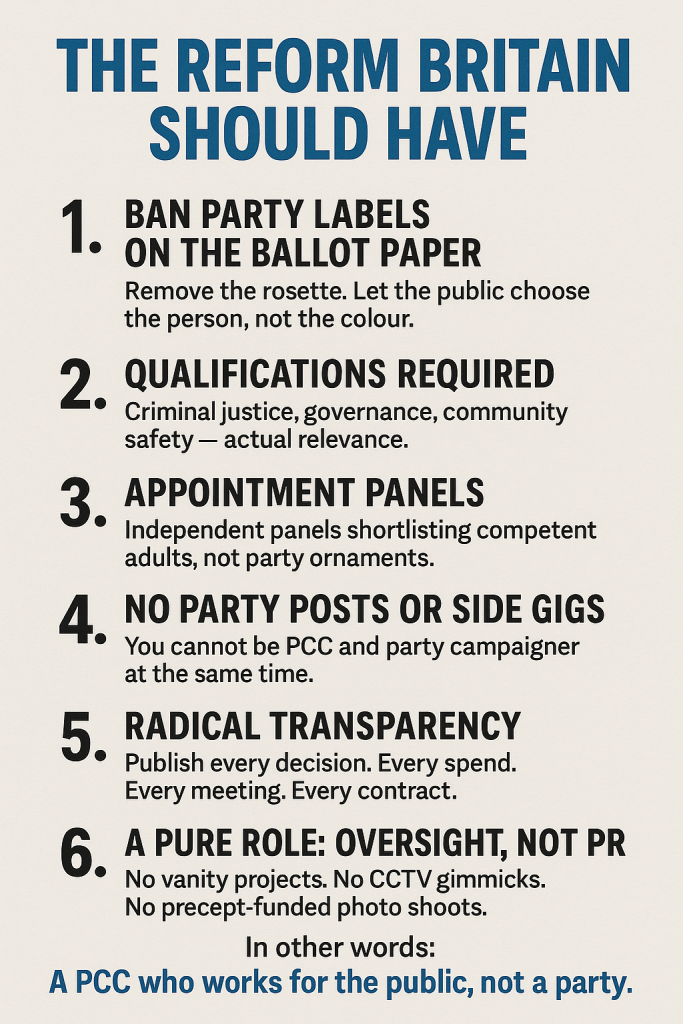
2. QUALIFICATIONS REQUIRED
Criminal justice, governance, community safety — actual relevance.
3. APPOINTMENT PANELS
Independent panels shortlisting competent adults, not party ornaments.
4. NO PARTY POSTS OR SIDE GIGS
You cannot be PCC and party campaigner at the same time.
5. RADICAL TRANSPARENCY
Publish every decision. Every spend. Every meeting. Every contract.
6. A PURE ROLE: OVERSIGHT, NOT PR
No vanity projects. No CCTV gimmicks. No precept-funded photo shoots.
In other words:
A PCC who works for the public, not a party.
THE FINAL INSULT: SCRAPPING THE PCC DOES NONE OF THIS
Instead of fixing what was broken, the Government is deleting the only name you could hold responsible.
A board of leaders won’t give you:
– a champion for rural policing
– an accountable signature on the precept
– a watchdog defending neighbourhood officers
– a figure the public can interrogate
– someone whose feet Commissioner Watch can actually hold to the flame
It will give you dilution, confusion, evasion, and the bureaucratic thrill of watching decisions vanish like socks in the wash.
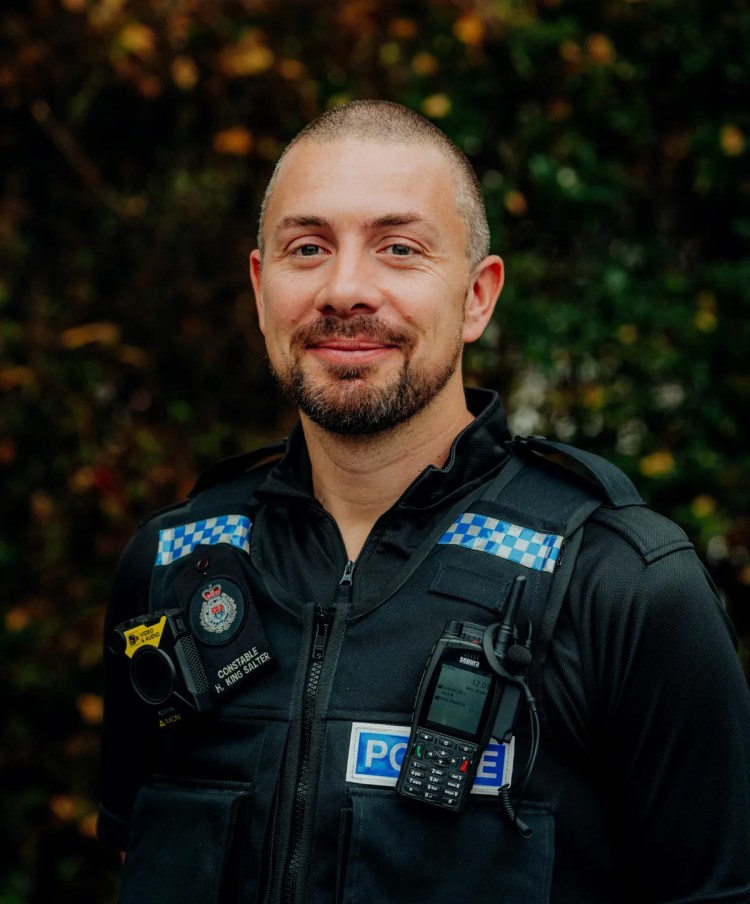
And this is what a proper copper looks like
Meanwhile note to Shropshire Council: Still 5 FOI’s outstanding.
Is there something you don’t want us to know?
 The Alternative Council