
How Homes England, the Councils, and Their Favourite Friends Built a System Only a Bureaucrat Could Love
Opening: The Gloves Come Off
Let’s begin with a confession: I used to think house building was simple. A bit of land, a few bricks, and a council officer who hasn’t mysteriously gone home at 3.45pm. But that was before I stumbled into the dazzling wonderland of “modern housing delivery” — a place where simplicity goes to die and public money goes to… well… places.
Now a question:
If you asked a reasonably competent adult to design a system for building affordable homes, would they:
A) Keep it simple?
or
B) Construct a 17‑lever contraption involving quangos, council‑owned companies, shared CEOs, and a fog machine labelled “Commercially Sensitive”?
Correct answer: B, obviously. This is Britain — and this is Shropshire, and this is ‘The Council’ in all its glory.
At the centre of this wonderland sits Homes England — the most powerful quango in Britain, that absolutely nobody has ever heard of. A body so low-profile that even MI5 must get jealous. A quango so elusive that if it ever tried to hold a press conference, it would probably redact itself before the cameras rolled. Yet these faceless wizards control the land, the money, the loans, the grants, the pipelines, the partnerships — and ultimately, the shape of every housing development from Telford to Timbuktu.
Around it orbit the usual suspects:

• Shropshire Council
• Telford & Wrekin Council
• Cornovii Developments
• STAR Housing
• Wrekin Housing Group
—and a supporting ensemble who drift in like background actors in a soap opera.
The result?
A Rube–Goldberg housing machine: wildly over‑engineered, faintly ridiculous, and one wobble away from detonating the entire PR façade they’ve spent years wallpapering over the cracks with.
HOMES ENGLAND — THE INVISIBLE HAND… IN EVERY PIE
If British housing were Cluedo, Homes England would be “in the conservatory with the cheque book,” dutifully denying it while standing under a neon sign flashing: “THIS WAY TO THE MONEY,” pretending it’s nothing to do with them.

Their fingerprints are everywhere — Majestic Way, Old Park, the brownfield grab‑bag, the Telford Land Deal — half of the regeneration schemes nobody even pretends to read the paperwork for.
But the organisation itself remains more elusive than a council officer after 3.45pm on a Friday — that’s of course if he’s not working from home.
They glide from one scheme to the next in soft‑soled shoes, issuing jargon so thick you’d need a machete to cut through it.
TELFORD & WREKIN — WHERE THE LAND DEAL MAKES THE WEATHER
The Telford Land Deal is a magnificent contraption: part planning strategy, part alchemy, part one‑armed‑bandit machine — and part optimistic shrug.
You feed in public land, optimism, and out pops a scheme that — surprise surprise — ends up in the lap of Wrekin Housing Group.
Majestic Way? Wrekin.
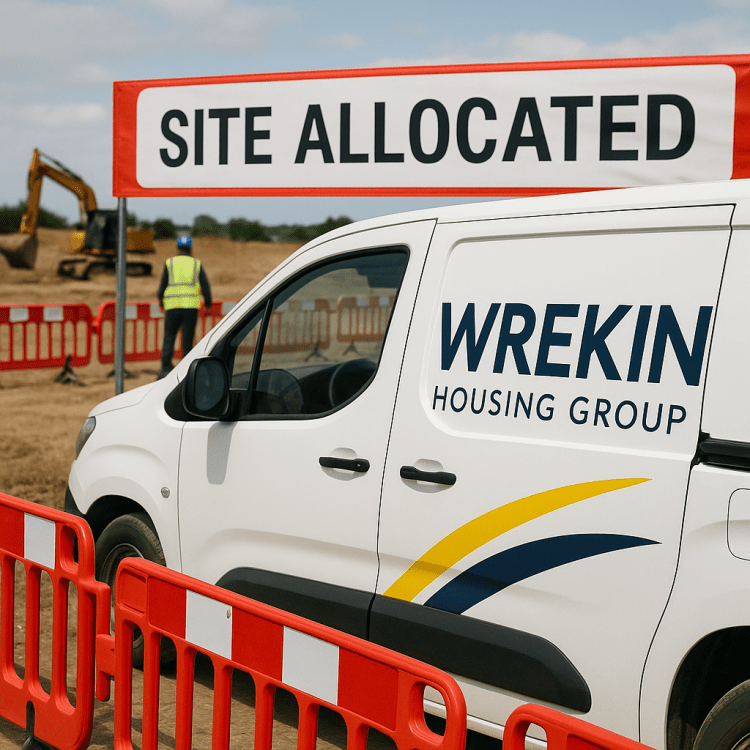
Old Park? Wrekin.
Newcomen Way? Wrekin again.
If Homes England dropped a sausage roll in Telford, a Wrekin van would reverse up before it hit the floor — hazards on, clipboard ready.
And if public funding had a loyalty card, Wrekin would be platinum.
WREKIN HOUSING GROUP — ALWAYS AT THE FINISH LINE
Gatcombe Way – £800k
Webb Crescent – £1m

Wendover House – £124k
Majestic Way – full development
Old Park – full development
Ellesmere – extra units approved
They’re not villains — just very well positioned. The sort of luck that would have a casino pit boss narrowing his eyes.
SHROPSHIRE COUNCIL — HOLD MY COSTA NOSTRA CAPPUCCINO
Not to be outdone, Shropshire Council created Cornovii Developments Ltd — their own in‑house developer.
Cornovii borrows from the Council, builds on Council land gifted by the Council, is overseen by directors appointed by the Council, and refuses FOIs submitted to… the Council. It’s basically a family business where nobody wants to admit they’re related.
Schemes include: Ifton Heath, Monkmoor, Ellesmere, Fraser Street/New Park Road.
Cornovii’s business plan admits reliance on Homes England the way a baby bird relies on its mum. Only the cheeping is louder.
STAR HOUSING — THE ALMO WITH THE SHARED CEO

STAR manages 4,200+ homes — but here’s the party trick:
STAR and Cornovii share the same Chief Executive.
The developer and the landlord effectively have the same captain. It’s not “arm’s‑length governance”; it’s “arm‑in‑arm at the Costa Nostra barbecue.”
At this point, the AGM might as well be held in someone’s dining room.
STAR’s strategy pledges to deepen partnership with Cornovii and strengthen ties with Homes England — essentially sending a Valentine’s Day card to itself.
This is called “efficiency”. The rest of us call it what it is: a closed‑loop housing cartel.
THE SUPPORTING CAST — HOUSING PLUS, SANCTUARY, BROMFORD

Housing Plus Group, for example, presents itself as a serene, values-driven organisation — the sort who could publish ten pages of “vision statements” without ever once mentioning where the land, the loans, or the money actually come from.
Different towns.
Different schemes.
Same logos.
Coincidence? Possibly. Pattern? Absolutely.
FOIs & THE FOG MACHINE — WHERE TRUTH GOES TO DIE
Ask for details and you receive a blackout edition of War and Peace.

Ask for valuations — “no longer exist”.
Ask again — everyone’s suddenly “working from home,” which is local‑government code for: “We’ve run out of excuses — give us a minute while we invent a new one.”
If FOI law had a face, Shropshire Council would be slapping it with a wet dishcloth and then hiding behind the filing cabinet until it went away.
NUCLEAR CLOSING
So next time Cornovii, STAR, Wrekin or Homes England wheel out a lectern, roll out their buzzwords and talk about “place‑shaping regeneration outcomes”, remember this:

Behind the banners sits a housing machine so convoluted, so incestuous and so opaque that it should come with a hazard sign.
Public land moves.
Public money moves.
Public risk moves.
Accountability does not.
And when — not if — the machine finally jams, expect statements, disclaimers and finger‑pointing.
But no one will say: “Yes. That was my decision.”
Because in this model, everyone’s in charge — which is exactly why nobody ever is.
And if you’re still wondering who’s in charge, the answer is simple:
Whoever wrote the press release — and only for as long as the camera’s rolling.
 The Alternative Council