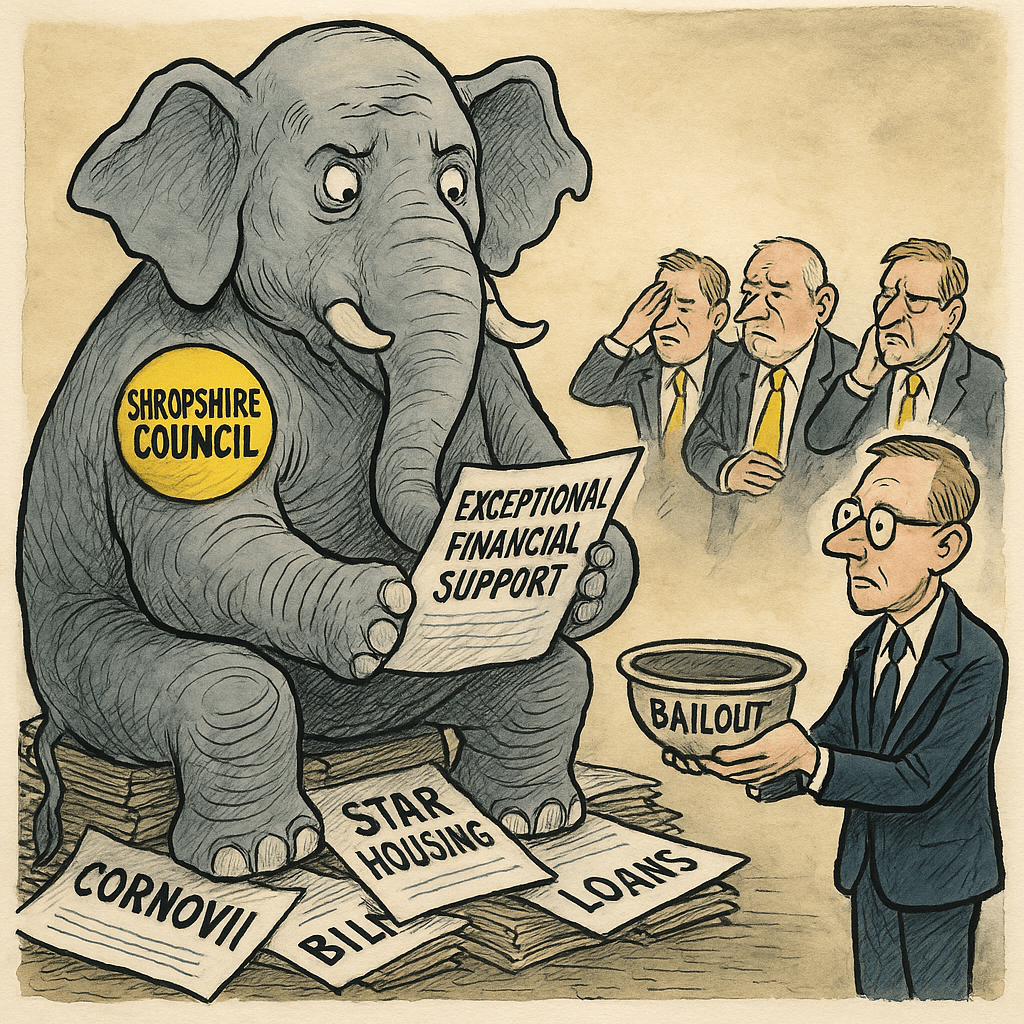
The beast arrives, sits on your wallet, and asks for a tip.
Let’s talk about the animal nobody’s feeding but everyone’s funding.
It’s grey, immovable — and financed on your credit card.
The new pastime
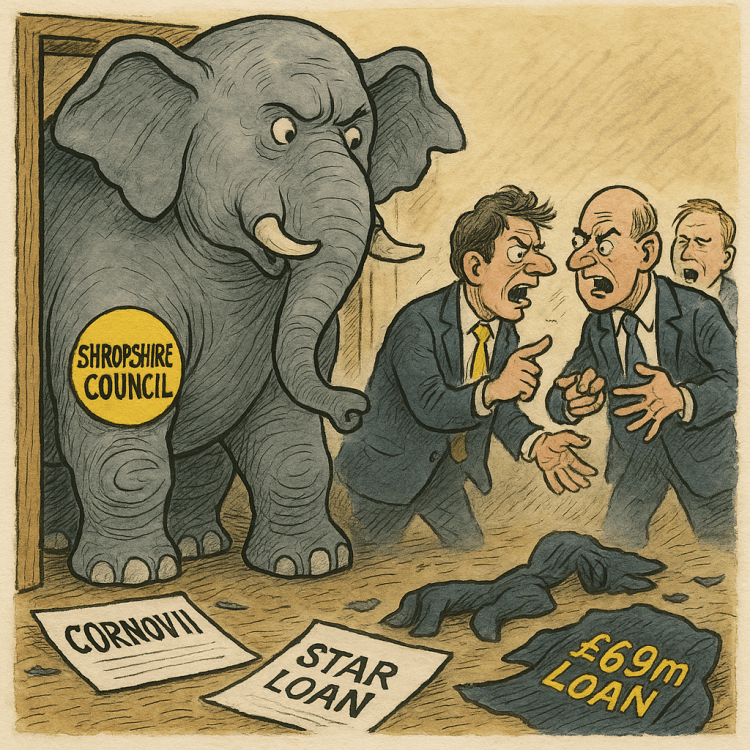
Shropshire has a new pastime: building houses with your land and your money, then calling it “commercial”. The developer has a smart name (Cornovii), a smart logo, and a smarter trick: a second company that parks some of the homes for private rent. And yes, the rent is paid by real people in the real world while the paperwork does yoga.
Don’t worry, they say — everything is safe, sensible, supervised. Splendid. Then showing the documents should be easy, shouldn’t it? We’ve asked for them. Five simple sets. No smoke. No mirrors. No black marker pens on every other line.
The short version (no jargon, no mercy)

• Your land and your loans have been used. We’ve asked for the receipts.
• A new “investments” company now holds homes for private rent. Great idea — until you notice the homes have slipped outside the council’s legal safety net.
• If the council ever formally admits it cannot balance the budget, the new money stops, the loans get tested, and valuable assets may be sold, seized, or shuffled. That thud you hear? The elephant landing.
Five questions any grown-up organisation should answer before breakfast
1. Loans: How many since 2019, how much actually drawn, what interest and fees, how and when repaid, what assets used as security, and who signed each drawdown with a straight face?
2. Land: Which public sites went into the developer, on what dates, for what prices, and which independent valuations blessed the deal?
3. Oversight: What do the shareholder and monitoring boards actually do when the slides run out? We want powers, minutes and performance reports.
4. STAR Housing links: Which services and staff are shared, which homes moved across, and what money changed hands? If it walks like a group and talks like a group, show us the group bill.
Ten homes at Ifton Heath have already been transferred into Cornovii Investments, with more earmarked at London Road. That’s public value quietly walking out of the charged company into its rent-collecting twin — the same one chaired and signed off by the same CEO, Harpreet Rayet. Imagine auditing your own homework and giving it a gold star.
5. The infrastructure levy (known as the Community Infrastructure Levy, or CIL): For every site, how much was due, which reliefs were claimed, what was paid and when, and what legal advice said “go on then”.
Why this matters (beyond hobbyists who collect council reports)

Price versus promise: if public land wandered off cheap without a crystal-clear, written public-benefit case, residents paid twice — once in lost value, again in risk. Two-for-one, no loyalty points.
“Commercial terms”: a beautiful phrase that should come with numbers. Show the rates, fees and controls next to what any lender would offer on planet Earth.
The rental side-vehicle: if lettable homes live in the new company without identical council charges, there’s a hole in the safety net exactly where the value sits. That’s not flexibility. That’s a skylight in a rainstorm.
The Risk Parade (mind the tusks)
Refinancing roulette: short, rolling loans that assume every unit sells on cue. Adorable. What’s Plan B when the market yawns and the council ends up asking the Government to step in?
Security gaps: if those rented homes aren’t locked under the same legal charges, recoveries shrink right when the bill arrives.
Infrastructure-levy trip-wires: miss a form, lose a relief, pay a surcharge — even if you’re your own favourite developer.
Paper oversight: if “scrutiny” means a Friday slideshow and a tray of sandwiches, risk breeds in the margins.
When the council begs the Government for a lifeline
The elephant now has its trunk in the Treasury. Shropshire Council has confirmed it has requested emergency support from the Government — labelled “exceptional financial support” — to keep services running until March 2026. It turns out the “commercial terms” gambit wasn’t enough to plug the holes: when you borrow your own money, box off assets, lean on private‑rent wings and call it “investments”, you still hit the wall when the buckets have holes.
The new administration says it inherited a budget that “simply doesn’t add up”, reserves that are exhausted, and a projected overspend of about £50 million by March 2026 unless corrective action happens now. So, if the developer vehicle, the housing side‑company, the asset transfers and the infrastructure levy (CIL) write‑ups were supposed to generate a “commercial return” — here’s the blunt truth: none of that saved the day. The council’s now preparing for Plan B: government bailout, spending freeze, and maybe an asset fire‑sale (or at least the threat of one).
For you and me? It means that your land, your loans, your homes and your oversight just became stickier. Because when the council’s back is against the wall, flexibility = risk, not freedom.
The question now morphs from “How much? Who signed? Where’s the security?” to “If the council calls in the Government, who picks up the tab next?”
Final Thoughts (and a Small Dose of Reality)

The Liberal Democrats promised change after the disastrous Conservatives; yet the only visible change is the colour of the rosettes. The same officers remain in charge, the same spreadsheets are recycled, and the same elephant continues to occupy the same room — only now it’s on a retainer.
We are told it’s all “commercial” — which apparently means borrowing your own money, lending it to yourself, charging yourself interest, and then asking the Government for a bailout when the calculator catches fire.
Ten homes have already been shuffled from Cornovii Developments to its private-rent twin, Cornovii Investments. The same CEO, Harpreet Rayet, signs both sides of the paperwork. It’s a bit like refereeing your own penalty shootout and still missing.
Meanwhile, the Council’s £69 million loan facility marches on, expected to peak at £56 million by 2027 — assuming every sale and rent lands on cue. But even a small stumble, and the “commercial venture” starts looking less like enterprise and more like self-inflicted insolvency.
Will Reform be any better? Possibly. Possibly not. But one thing is certain: the current system is broken — stitched together with jargon, risk, and unearned self-belief. The children have been playing at government long enough.
They’ve had their chance. It’s time for the grown-ups to take over — preferably the kind who can count past election day.
And yet again, this Council has blundered into another commercial venture it doesn’t comprehend — as if making the same bad decision twice might, by some miracle, make it work the third time.
As of today Shropshire Council is 1 week late in answering a Freedom of Information Act request relating to the above.
Not saying they are trying to hide anything, BUT.
 The Alternative Council