
A Masterclass in Doing Less With More

West Mercia gives us a masterclass in modern policing: replace officers with cameras, replace accountability with press releases, and replace transparency with a £25 million umbrella called the Office of the Police and Crime Commissioner. The result? CCTV that doesn’t work, complaints that don’t count, and a bureaucracy that eats 9% of the police budget while delivering almost nothing to the street. The sort of miracle only local government could admire.
Cameras Instead of Cops
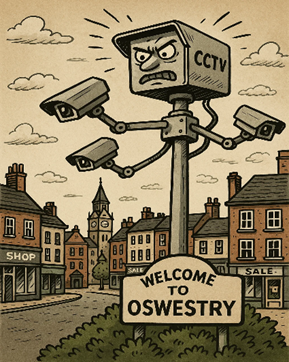
Market towns like Oswestry have been handed CCTV systems and told to be grateful. Yet Freedom of Information requests show the cameras regularly break down, the paperwork to justify them doesn’t exist, and requests for footage are quietly refused. West Mercia Police themselves cannot even say how often CCTV helps solve crime — because they don’t bother to measure it.
And when the cameras do work, they always seem to be pointing in the wrong direction. Strange, that — almost as if catching criminals were never the point.
It’s policing by placebo: you feel watched, you get the invoice, but justice is nowhere to be seen.
The £25 Million Umbrella

Meanwhile, the PCC’s budget has ballooned from £20 million to £25.5 million in just two years. That’s nearly 9% of the entire West Mercia policing budget. To put it in perspective, the same money could buy 400 officers, 600 PCSOs, or 830 patrol cars. Instead, it buys 67 administrators, glossy “plans,” and estates managers.
If crime were solved by strategy documents, West Mercia would be the safest patch in Britain. Sadly, criminals remain unmoved by glossy brochures, pie charts, and laminated action plans.
The Complaints Carousel
Since 2020, the PCC has been reviewing complaints about the police. In theory, this is oversight. In practice, it’s the overseer marking his own homework. Very few complaints upheld, very little daylight, and absolutely no independence. Victims get tidy rejection letters sprinkled with “service recovery” and “lessons learned,” while misconduct sails serenely on. The only thing spinning faster than the carousel is the £ it costs.
Justice may be blind, but in West Mercia it’s also deaf, mute, and employed on a fixed-term contract. With the performance review postponed indefinitely, of course.
Transparency by Omission

Requests for CCTV logs? Buried. Privacy notices? Missing. Downtime figures? Shuffled away. Victims who try to obtain footage are routinely refused. Accountability, it seems, is not part of the service package.
It is a miracle of modern bureaucracy: an entire system built on cameras, without a single lens trained on itself. A self-portrait in failure, beautifully framed at public expense.
An Empire of Estates
The OPCC now employs 67 staff and has quietly taken over the management of police estates. Bricks and mortar receive more love than beat officers. Paper-pushers multiply like rabbits while the village bobby goes the way of the dodo. The Commissioner presides over an empire of buildings, policies, and PR — everything except justice.
A Different Way: Local Justice in Oswestry

Of course, pointing out the failures is the easy part. The harder question is: what would actually work? Luckily, Oswestry has already written the answer on the back of its own history.
The town’s crime rate is the highest in Shropshire — shoplifting runs at 3.8 times the national average. Anti-social behaviour and petty theft wear down residents and shopkeepers alike. Yet every case is dragged 30 miles to Telford, with delays of weeks or months. Victims give up, shopkeepers stop reporting, and offenders learn that consequences are optional.
The solution is hiding in plain sight: reopen the Guildhall Magistrates’ Court, linked with Park Street police station.
– Swift justice: suspects arrested in Oswestry could face magistrates within 24–48 hours, not six months.
– Cut police waste: officers would stop wasting half their shift ferrying prisoners to Telford.
– Boost confidence: victims and witnesses would see justice done locally, promptly, and visibly.
– Affordable: setup about £300,000–£400,000, running approximately £250,000 per year — a rounding error in the PCC’s £25 million empire.
– Symbolic: the sight of offenders climbing the Guildhall steps sends a message CCTV never could.
This is not fantasy. Reports, costings, and operational models already exist. Stakeholders from the Ministry of Justice to Oswestry BID to Oswestry Town Council have been identified. Funding routes — Levelling Up, Safer Streets, Home Office — are on the table.
In short: where the PCC gives us cameras that don’t work, Oswestry could give us justice that does.
Does Oswestry Town Council have the courage to take the first step, or is the money safer gathering dust than serving the town?
Curtain Call
So here we are: millions spent, cameras that don’t work, complaints that don’t count, and a Commissioner’s office that has become the biggest spectator sport in West Mercia.
If this is “safer communities,” then perhaps next year’s innovation will be cardboard cut-outs of police officers — cheaper than CCTV, equally effective, and at least honest about being for show.
The truth is unavoidable: the PCC model is not just flawed — it is a con. And like every con, it only works as long as we play along. Perhaps it’s time we stopped. Refunds unavailable. Terms and conditions most certainly apply.
Daylight doesn’t just audit — it prosecutes.

 The Alternative Council